

Dispatch: Hantavirus claims debunked as MV Hondius reignites Covid-19 conspiracy theories
New claims linked specifically to hantavirus emerged, while familiar theories from the Covid-19 pandemic were revived for 2026

An outbreak of hantavirus infection on board a Dutch cruise ship called the MV Hondius, which came to light in early May, led to the deaths of three people and the infection of several others.
The cluster of infections, caused by the Andes strain, led to a flurry of contact tracing around the world and particularly in Europe, where several people who had earlier disembarked the cruise were forced to self-isolate.
The World Health Organization, in its most recent update, said the working hypothesis is “that the first case acquired the infection prior to boarding the cruise, through exposure on land … Current evidence suggests subsequent human-to-human transmission onboard the ship”.
The story gripped social media as well as traditional news channels. Interest was fanned by the initial mystery surrounding the transmission of the virus, as well as its echoes to the very recent Covid-19 crisis, which itself prompted a huge number of conspiracy theories to which some people remain loyal to this day.
The following fact-checks were analysed by members of Eurovision News Spotlight.
Hantavirus is not a side-effect of the Covid-19 vaccine
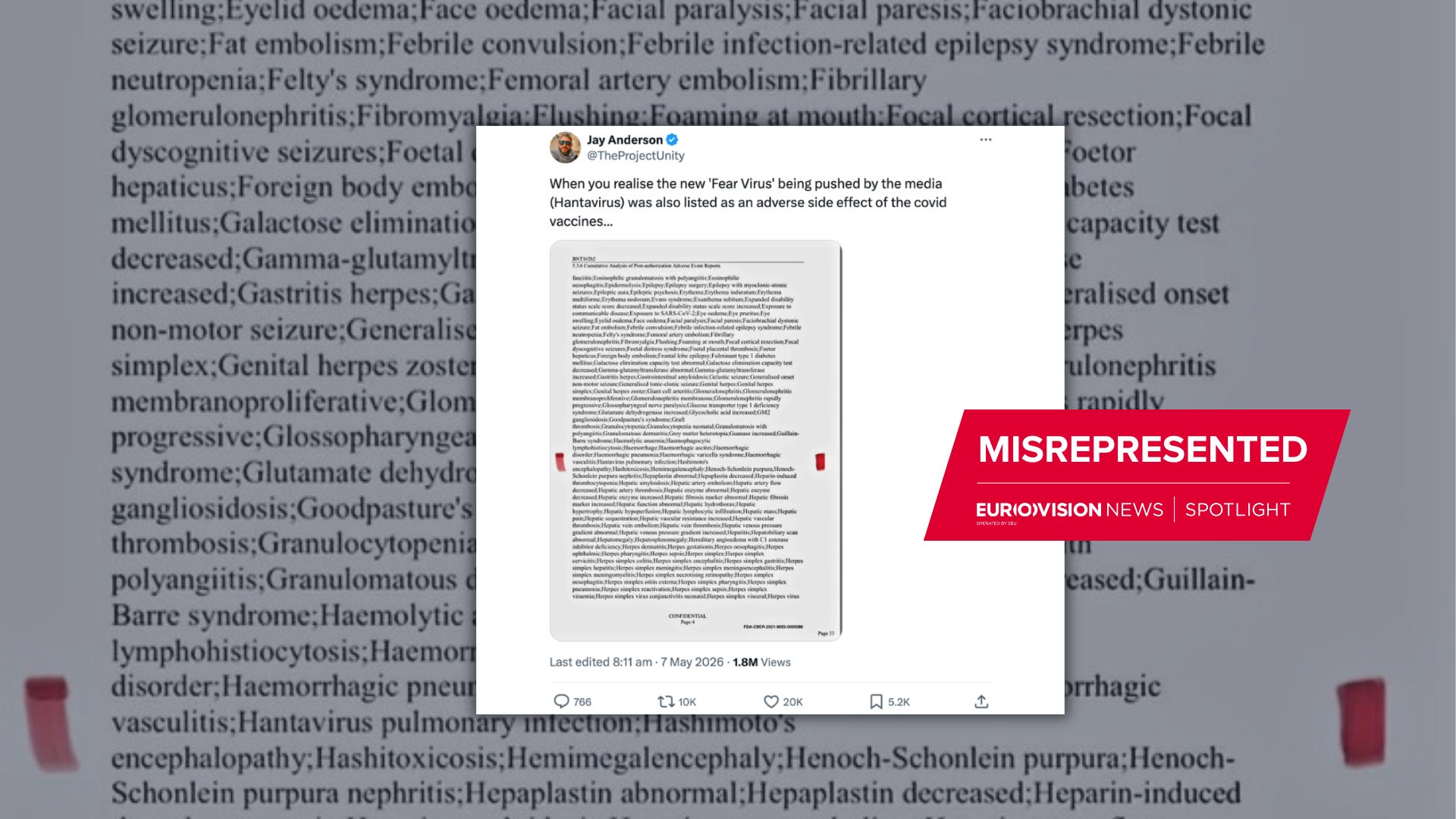
An old document from pharmaceutical giant Pfizer was being cited on social media to prove that the outbreak on board the MV Hondius was a side-effect of Covid-19 vaccines.
The 2021 document from Pfizer appeared to show that hantavirus was mentioned as a potential side-effect. Posts with screenshots of the Pfizer document were circulated widely in English and other European languages, racking up millions of views.
Virologist Steven Van Gucht, speaking to Belgium’s VRT, said the claim was incorrect and urged people not to worry. “Hantavirus pulmonary infection is indeed mentioned in an appendix to the Pfizer document, but that is a list of ‘adverse events of special interest’: all medical conditions or events that a person experiences during the vaccine’s trial period.”
In a vaccine trial period, all such “adverse events” must then be reported. It does not mean that they are caused by the vaccine, nor that they are recognised side effects. Such reports could just as easily be related to underlying disease, coincidence, exposure to a pathogen, or other factors.
Meanwhile, the president and spokesperson of Spain’s Asociación Nacional de Enfermería y Vacunas (ANENVAC), José Antonio Forcada, told VerificaRTVE that it is "impossible" for a vaccine like Pfizer's to cause a virus to appear, since it doesn't contain a virus because it's made with messenger RNA.
The European Medicines Agency also commented on the claims, saying: “EMA cautions against misinformation circulating online that falsely links hantavirus infection to COVID 19 vaccination, as there is no scientific evidence to support such claims.”
VRT NWS Check: No, an infection with the hantavirus is not a side effect of the COVID-19 vaccine
VerificaRTVE: Hantavirus is not a side effect of the coronavirus vaccine; it's a hoax
RTBF Faky: Hantavirus infections are not linked to a side effect of the Pfizer Covid vaccine
3CatInfo: Misinformation about hantavirus: there is no effective vaccine and it is not related to Covid
Hantavirus stirs up conspiracy theory sphere haunted by Covid
The Pfizer document wasn’t the only reference to Covid-19; the latest hantavirus outbreak stirred up a whole genre of conspiracy theories that had lain mostly dormant since the global pandemic of earlier this decade.
These included vaccine misinformation, theories about ‘weapons’ of mass depopulation, and miracle cures not backed up by available research.
Prominent conspiracy theorist Alex Jones posted on X: “LOCKDOWN ALERT: Globalists Launch Covid 2.0 As Hantavirus Spreads Worldwide, EU Tells Citizens ‘MASK UP,’ Stoking Hysteria!”

You don’t have to have a very long memory to recall the talking points of the Covid pandemic. Several of them re-emerged on social media in recent weeks, including a theory that hantavirus is the latest “plandemic”, a “biological weapon” released by pharmaceutical companies to necessitate their vaccine products.
Some of the medications we’ve heard about before were also promoted once again as cures, like anti-parasitic drug ivermectin. Republican congresswoman Marjorie Taylor Greene was one of those who touted the drug, citing an anti-establishment doctor whose claims have been debunked by the wider medical community.
Bill Gates, who often prominently features in this genre of conspiracy theory, also made a return.
France24: Hantavirus scare revives Covid-era conspiracy theories
Panic over potential for infected rats to swim ashore
As the crisis on board the Hondius was deepening, officials were discussing where the virus-stricken cruise might dock.
The president of the Canary Islands government, Fernando Clavijo, consistently opposed the MV Hondius' arrival in Tenerife for the evacuation of passengers. One of his arguments, made just hours before disembarkation, was that he feared rodents might come ashore and endanger the safety of the Canary Islanders.
However, the Ministry of Health maintained that there were no rats on board, and six experts consulted by VerificaRTVE said that it was highly unlikely any could reach the coast and spread the hantavirus anyway. A Ministry of Health report document said that “based on inspections carried out by experts on board, no rodents have been detected, and the probability of an Andean rodent from a mountainous habitat boarding the ship and swimming to the Canary Islands coast is nil”.
RTVE spoke to a number of experts to establish the facts about the distance rats can feasibly travel in water, after communications among local officials about rats’ excellent swimming ability as the vessel was anchored out at sea. (The plan was that passengers would be ferried to shore at a location far from residential areas.)
The verdict? These types of rats can swim, but they would generally lack the capacity to swim almost a kilometre to shore.
The World Health Organization also insisted that there was minimal risk to the public from passengers of the MV Hondius.
VerificaRTVE: There are no rats in Hondius and it is "highly unlikely" that they could reach the coast and infect the Canary Islanders