


With millions of followers, Yang Mun and his videos addressing ‘ancient wisdom for modern life’ have clearly struck a chord with social media users looking for deeper meaning.
The videos are serene: an elderly East Asian monk, often in an orange robe, sitting cross legged in a perfectly manicured garden or inside a temple. Sometimes he has a book in front of him, and in all of the clips, he imparts a piece of advice or inspiration.
“The sooner you learn this, the lighter your life will feel. Most of your suffering does not come from what is happening. It comes from the resistance to what is. You fight the moment,” he says in one of his recent videos.
In another: “I see how tired you are. Not just in the body but in the place where the heart holds everything together. You have been carrying more than you show.” Sometimes, he refers to viewers as “my child”.
The sentiments are positive and generalized, but draw on Eastern traditions — particularly Buddhism, based on the clothing and statues seen in the background of some of the videos.
So far, nothing seems amiss. Except: Yang Mun is not real.
All of his videos are entirely AI-generated, created with Google software, as confirmed by Google’s own AI detector, SynthID.
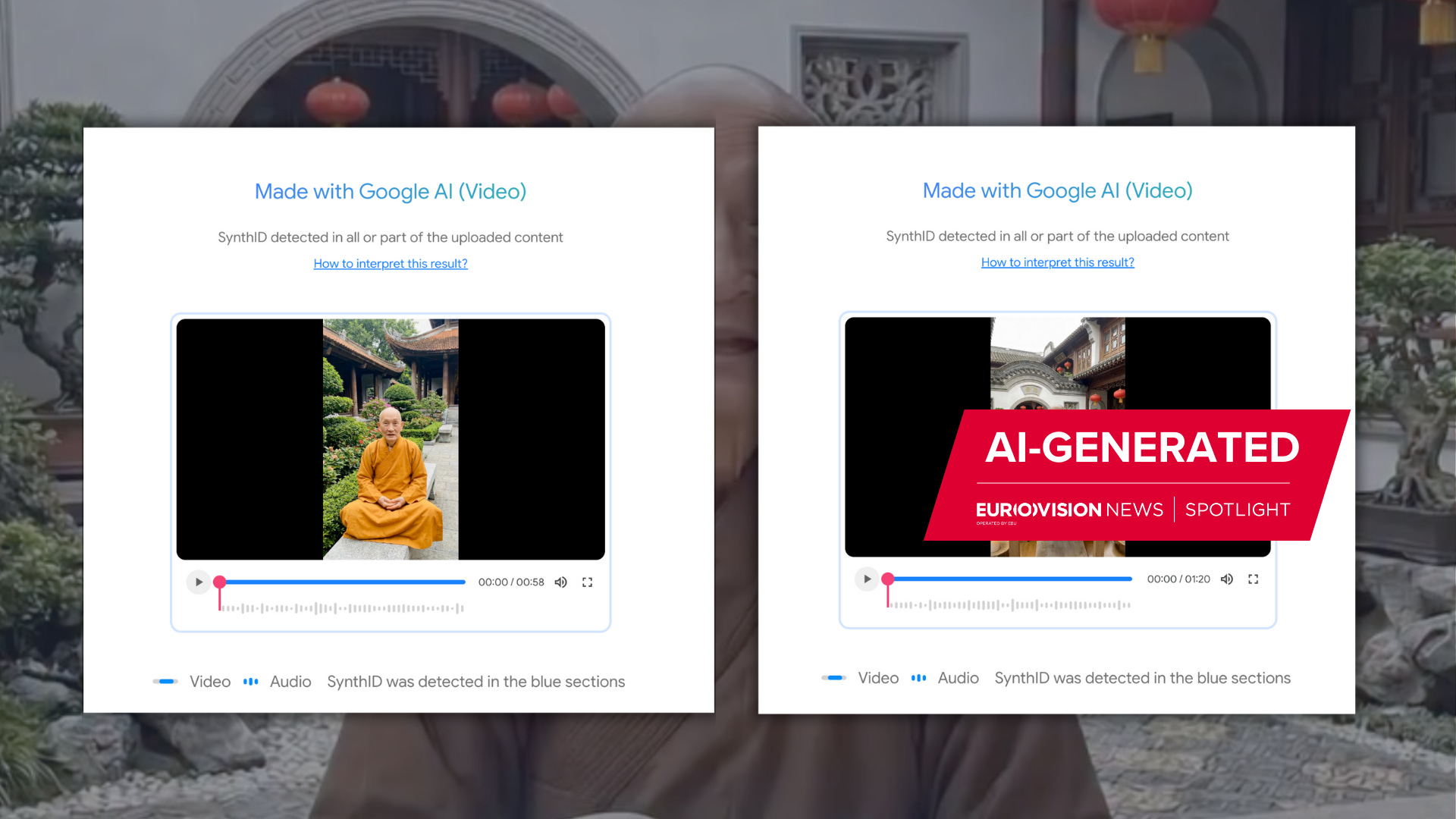
Yang Mun is mostly popular on Instagram, where two profiles have 2.5 million and 1 million followers respectively. On Facebook, a page for Yang Mun has 1.4 million followers.
There is an ‘AI info’ tag on the posts, but this does not appear prominently and does not give further details on the type of transformation that has taken place with AI. For example, a genuine image or video that has been retouched with AI may also carry this tag.
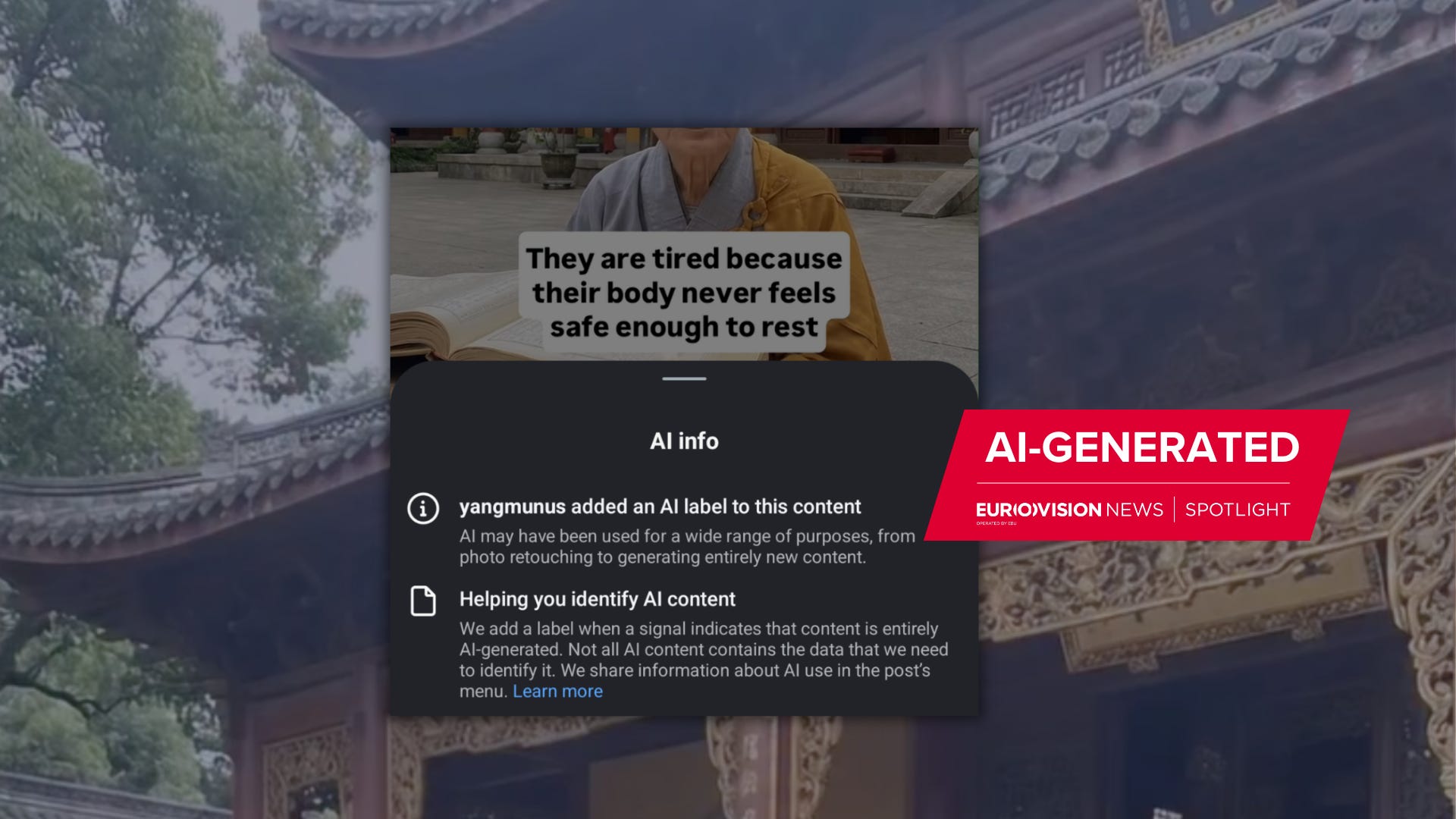
Meta’s current policy relies on uploaders to voluntarily disclose their use of AI, which critics argue allows synthetic content to bypass detection systems.
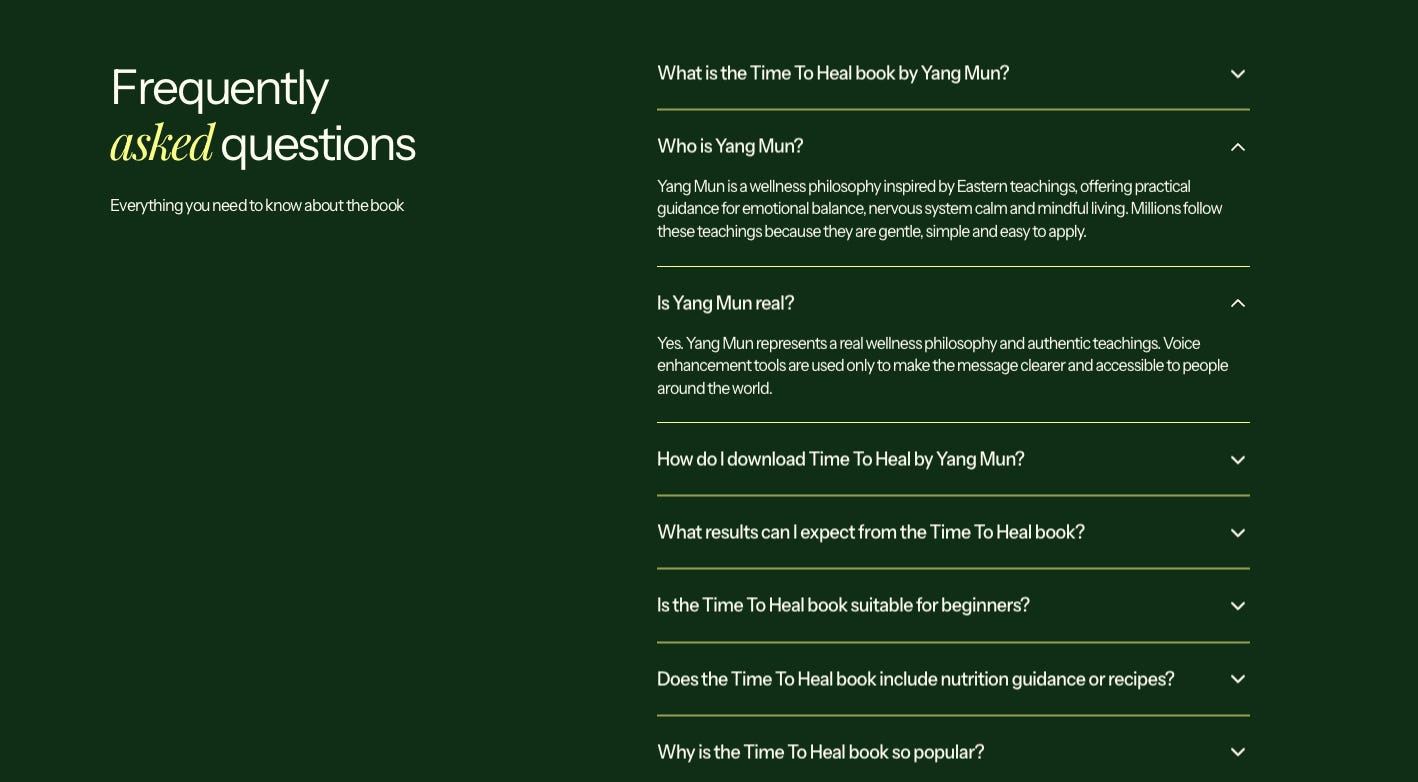
The website for Yang Mun addresses AI concerns in its FAQ section. Under the question “Who is Yang Mun?”, the website says: “Yang Mun is a wellness philosophy inspired by Eastern teachings, offering practical guidance for emotional balance, nervous system calm and mindful living.”
“Is Yang Mun real?” is answered with: “Yes. Yang Mun represents a real wellness philosophy and authentic teachings. Voice enhancement tools are used only to make the message clearer and accessible to people around the world.” But SynthID clearly shows that the visuals are entirely watermarked as Google-made AI — and more than just “voice enhancement tools” have been used.
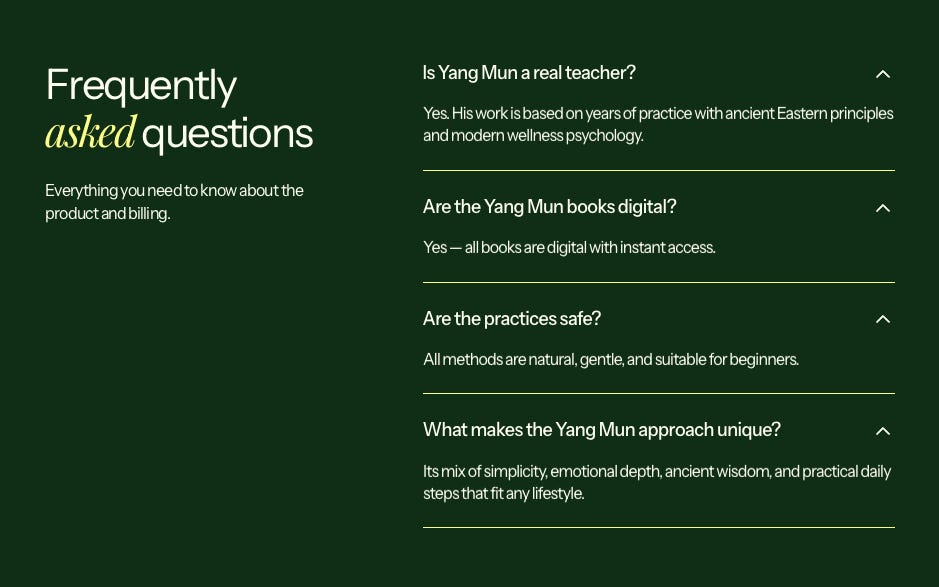
Furthermore, another page of the website features a different version of the FAQs. Under “Is Yang Mun a real teacher?”, the website states: “Yes. His work is based on years of practice with ancient Eastern principles and modern wellness psychology.” This contradicts findings from Google’s SynthID, which identifies the visuals as AI-generated.
Valuable income stream for creator
The huge numbers of followers accumulated by the Yang Mun brand suggest that many are not aware that he is AI-generated. Others may not care; his sentiments are motivational, inspirational, and relatively vague.
But this deceptive content represents a significant income stream for the creators. As well as any potential income from social views alone, a series of e-books — Time to Heal, Healing the Modern Soul, The Way Back to Stillness, and 30-Day Healing Journey — are available on the Yang Mun website for between US$10 and $50 before tax.
According to the website, more than 7,000 people have bought one of the e-books so far, and hundreds more have purportedly bought the more expensive package. The information on what is included in the package is vague, and users are immediately prompted to ‘Get Instant Access’ for a total US$61.45. The nature of the e-book content remains unverified, although the production speed of the brand aligns with AI generation patterns.

We checked the profiles of some of the few people who ‘reviewed’ the e-book on the purchase page. Most did not have profile pictures, but one reviewer who gave the books a five-star rating had a highly polished image with some irregularities in the skin, hair and eyes. HiveModeration, a third-party AI-detection platform, rated that picture as 99.9% likely to contain AI-generated or deepfake content.
There is no clear information on the website about who is behind the Yang Mun brand, but online searches throw up some indications. An article described as a ‘paid press release’ was published on Yahoo!Finance on December 9, 2025, and extolled the virtues of this “movement reaching millions worldwide” while urging readers to purchase a Yang Mun book.
It was released by Shalev.H Marketing. A search for this marketing firm brings up nothing but other paid content promoting Yang Mun. However, it appears to be a reference to Shalev Hani, who describes himself on LinkedIn as a “Digital Creator & AI Storyteller” based in Israel.
His LinkedIn page says that he “crafts AI-powered video content that enables brands and apps to scale effectively”, adding that he has “contributed to campaigns that collectively achieved over 330 million views across platforms”.
There is no mention of Yang Mun on the LinkedIn page now. However, a cached version of Hani's LinkedIn profile, indexed by Google and still appearing in search results this week, still lists him as the creator of Yang Mun.

Eurovision News Spotlight contacted Shalev Hani for confirmation. In a response, he wrote: “I’m not the right person to comment publicly on the nature or background of the Yang Mun character”, and added that he did not want to participate in media discussions on the project.
There was no evidence that anyone with medical or spiritual qualifications has anything to do with the project.
Religions and influencer industry facing AI challenge
AI is now a feature of almost every facet of the online sphere, but the subgenre of AI offering spiritual or mental health advice poses particular ethical questions. Popular discussions on the topic so far have mainly focused on the impact of AI chatbots; for example, in 2025, a group of leading psychologists in the UK warned that ChatGPT was offering dangerous advice to mentally ill people.
Mainstream religions are also grappling with the developments in AI. In 2024, an AI “priest” called Father Justin designed to answer faith questions sparked backlash and led to his ‘defrocking’ and the removal of all references to him being a priest.
A BBC article in October titled “People are using AI to talk to God” quoted a research fellow at the University of Oxford, the Reverend Dr. Lyndon Drake, as saying “AI chatbots might indeed challenge the status of religious leaders”, but he warned that “interpretations of sacred texts have often been contested” and chatbots mirror the biases of their training material.
In the content creator world, AI influencers are threatening to upend the influencer industry at large, which is worth hundreds of billions of dollars. Human influencers cannot possibly keep up with the output that is possible with an AI influencer, whose videos may only take minutes to generate.
For years, verification experts have contended with fake and AI-generated images from war zones and major news stories. Now, even the lifestyle content we were once drawn to for its relatability could be lost in a wave of increasingly undetectable synthetic content.
SOURCES
Instagram.com. (2017). Yang Mun (@yangmunus) • Instagram photos and videos. [online] [Accessed 20 Jan. 2026].
Instagram.com. (2017). Yang mun (@itsyangmuns) • Instagram photos and videos. [online] [Accessed 20 Jan. 2026].
Yang Mun. (2026). About Yang Mun – Ancient Wisdom for Modern Healing. [online] [Accessed 20 Jan. 2026].
Yang Mun. (2025). 30-Day Healing Journey | Yang Mun. [online] [Accessed 20 Jan. 2026].
Shalev.H Marketing (2025). Who Is Yang Mun? The Movement Reaching Millions Worldwide. [online] Yahoo Finance. [Accessed 20 Jan. 2026].
Hall, R. (2025). ChatGPT-5 offers dangerous advice to mentally ill people, psychologists warn. [online] the Guardian. [Accessed 20 Jan. 2026].
Christian, G. (2024). AI ‘priest’ sparks more backlash than belief. [online] National Catholic Reporter. [Accessed 20 Jan. 2026].
Arora, S. (2025). People are using AI to talk to God. [online] Bbc.com. [Accessed 20 Jan. 2026].
Venkatraman, S. (2025). Both of these influencers are successful - but only one is human. [online] Bbc.com. [Accessed 20 Jan. 2026].
Hivemoderation.com. (2026). Hive Moderation. [online] [Accessed 20 Jan. 2026].
Hello, when you visit yangmuns.com/contact very down in the page is simply written "© 2025 YangMuns.com — Operated by Maor Hani, Shalev Hani". :))