


The Israeli and U.S. strikes on Iran on Saturday, February 28 and the resulting retaliatory strikes from Tehran saw the outbreak of the world’s newest war last weekend.
On the war’s first day, Iran’s Supreme Leader, Ayatollah Ali Khamenei was assassinated along with other key figures from his regime. While the initial attacks were concentrated in Iran and early retaliations targeted U.S. and Israel-related sites in the Middle East, the conflict quickly widened — with Israel focusing on Lebanon and Iran targeting Gulf states. The impact was soon felt in locations across the region and even further afield.
Just five days in, the impact of AI-generated content and false claims circulating on social media was already being keenly felt. False material was being shared as real, and real images were being incorrectly flagged as false.
US and Israeli attack on Iran unleashes flood of fakes
The accelerating quality of AI models and the proliferation of AI-generated material in recent months created the perfect conditions for any new war to become a key target for fake material, muddying the waters of what we can trust coming out of a conflict zone.
BBC Verify’s Shayan Sardarizadeh, who has been following and live-posting throughout the war to debunk fakes and verify real footage, said early on March 4 that “this war might have already broken the record for the highest number of AI-generated videos and images that have gone viral during a conflict”.
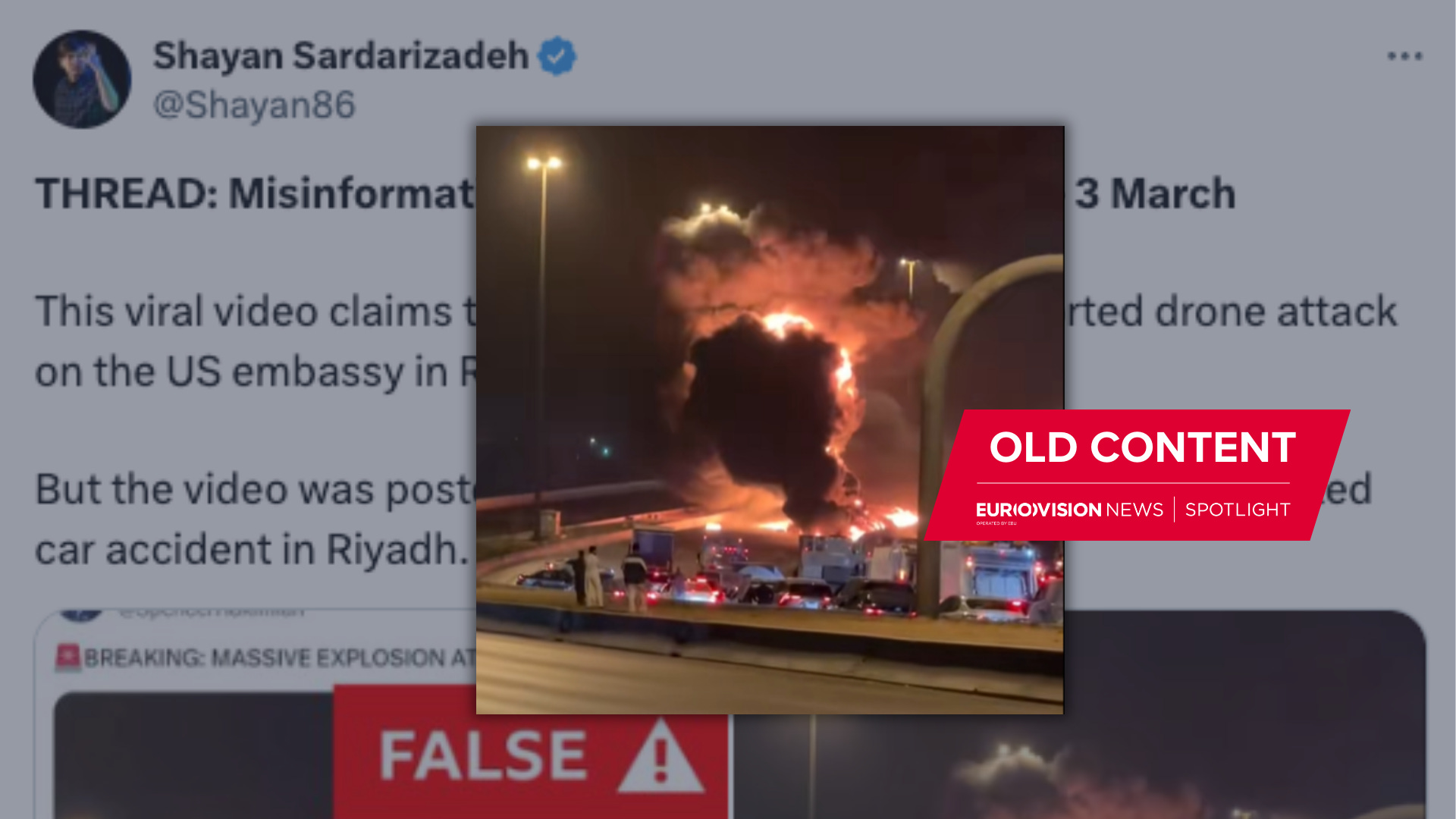
His daily threads compiling the war misinformation have covered aspects across the whole region. One viral clip claimed to show the aftermath of a drone attack on the U.S. embassy in Riyadh, Saudi Arabia, but in reality it showed an earlier, unrelated car accident in Riyadh. That clip was reshared by high-profile accounts, helping to further spread the false claim.
Even official accounts require close inspection, particularly in times of war. The official account for Israeli Prime Minister Benjamin Netanyahu posted a 72-second video on social media in which he appeared to speak Farsi, the official language of Iran.
In the clip, Netanyahu directly addressed the citizens of Iran, calling on them to soon “take to the streets” and “finish the job” of overthrowing the regime. The image was real, but the audio was AI-generated, VerificaRTVE found. Netanyahu doesn’t actually speak Farsi, and there are some errors with the lip-sync in the footage.
Many other Eurovision News Spotlight members have extensively covered the false content that has been spreading about this new war:
franceinfo: Beware of fake images circulating about the war in the Middle East
VerificaRTVE: Fake news, photos and videos of the US and Israeli attack on Iran
BBC Verify: Debunking AI fake images and disinformation about US-Israel war with Iran
VRT nws: How badly was Dubai affected by Iranian attacks? The Burj Khalifa was not hit
Verifying deadly attack on school in Iran
Among the stories that sparked the biggest reaction of the first weekend of the war was the deadly attack on an elementary school in Iran, which killed at least 168 people, many of them children.
The school in Minab was the subject of three airstrikes, according to the town’s mayor cited in news reports. The outrage over the deaths at the school represented a flash point for anti-war activism in the U.S. The origin of the attack remains unknown and no party has yet claimed responsibility.
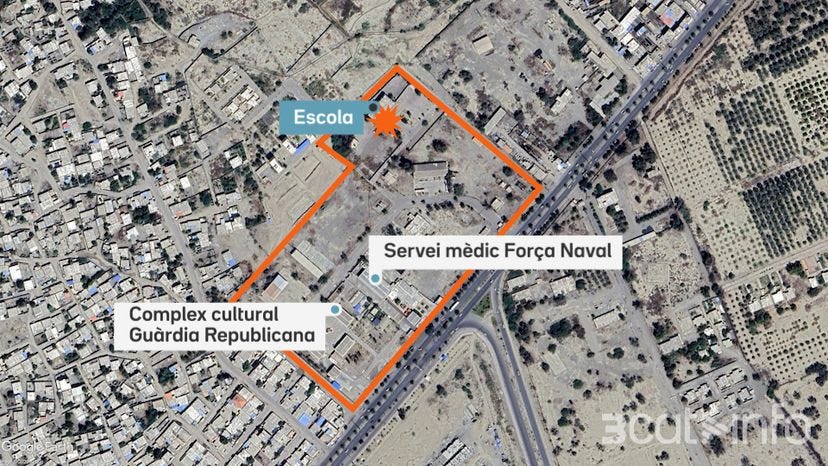
Collaboration between Eurovision News Spotlight members made geolocation of the school site possible. Satellite imagery of the area showed that the school is near two Revolutionary Guard buildings identifiable by signs in Farsi, Carlos Baraibar from 3Cat Info wrote. Eyewitness videos that were circulating after the attack allowed journalists to further confirm the area.
The incident also prompted misinformation, which in one case was even amplified by X’s built-in AI tool, Grok. For VerificaRTVE, Montserrat Rigall wrote about claims that RTVE and other news outlets had published a fake image to depict the destruction. The image was actually real, and contrary to claims, had no relation to a 2021 attack in Kabul, Afghanistan.
Social media users asking Grok to verify the image relied on its incorrect response that the image was old. “For hours, Grok insisted on its mistake and even called the media reports a hoax, while accepting messages from disinformation accounts that did not provide any evidence or rely on any source”.
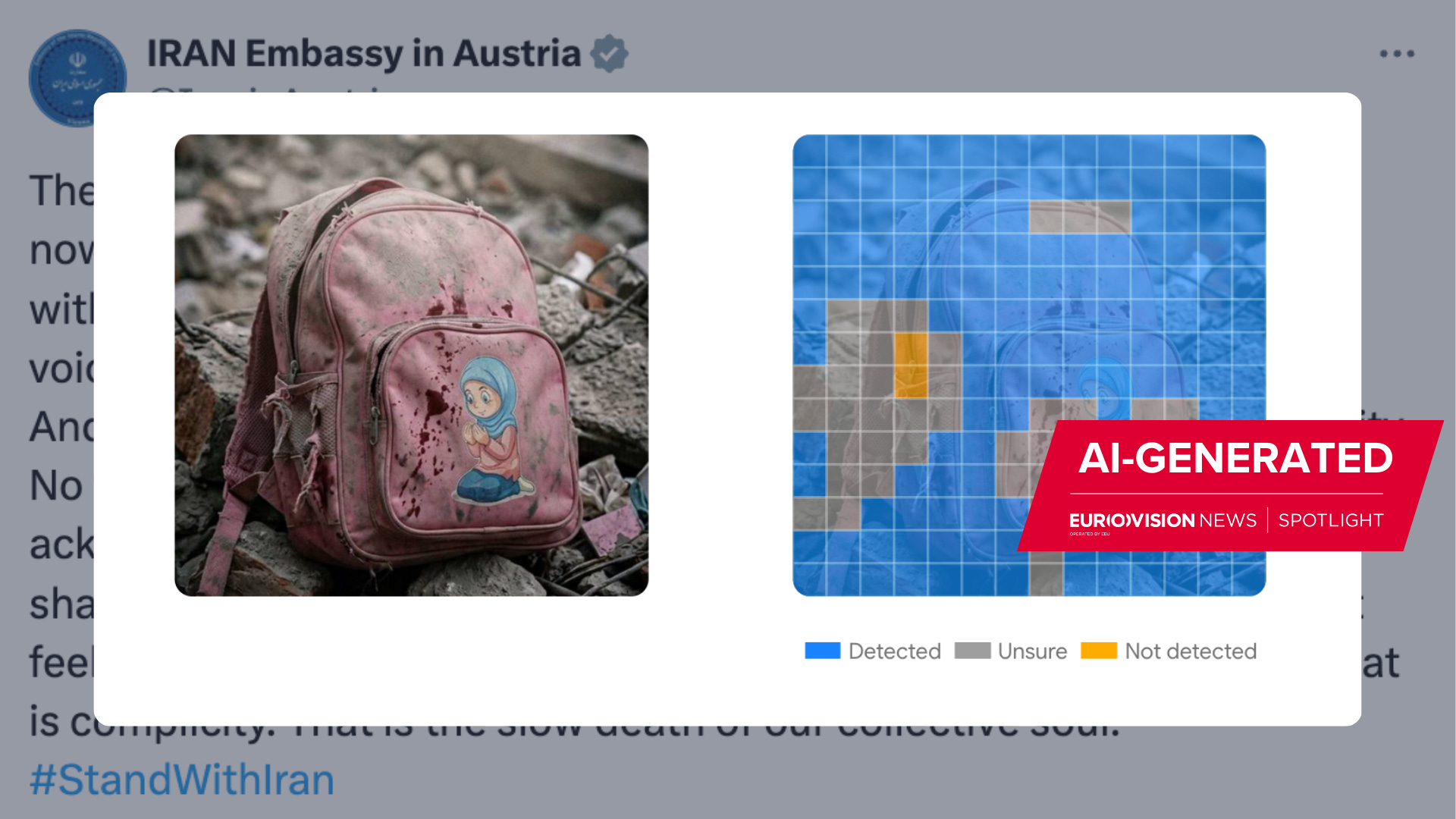
Another fact-check published by Mario Pérez Galindo of VerificaRTVE highlighted a fake image of a blood-spattered schoolbag that was published by the Iranian embassy in Austria. Google’s SynthID detector tool confirmed that it was created with Google AI.
For VRT nws, Daan Nicolay, Tom Buytaert and Bram Vandendriessche compiled an article detailing a number of other instances of misinformation circulating about the attack, including a claim that Iran’s Revolutionary Guard took responsibility for the incident. No official source had made such a statement at that time. Many social media users also speculated that it would be unlikely for so many children to be at the school on a Saturday, but Saturday is indeed a school day in Iran.
Dubai fascination as UAE dragged into conflict
On Western social media feeds, there has been a particular focus on Dubai as it was sucked into the war via retaliatory Iranian strikes. The modern Emirati city is a major ‘expat’ hub and is home to hundreds of thousands of Europeans.
As the first strikes came down on Dubai, a wave of content spread online showing rockets hitting the Burj Khalifa and the airport burning. It was not immediately obvious which images were real.
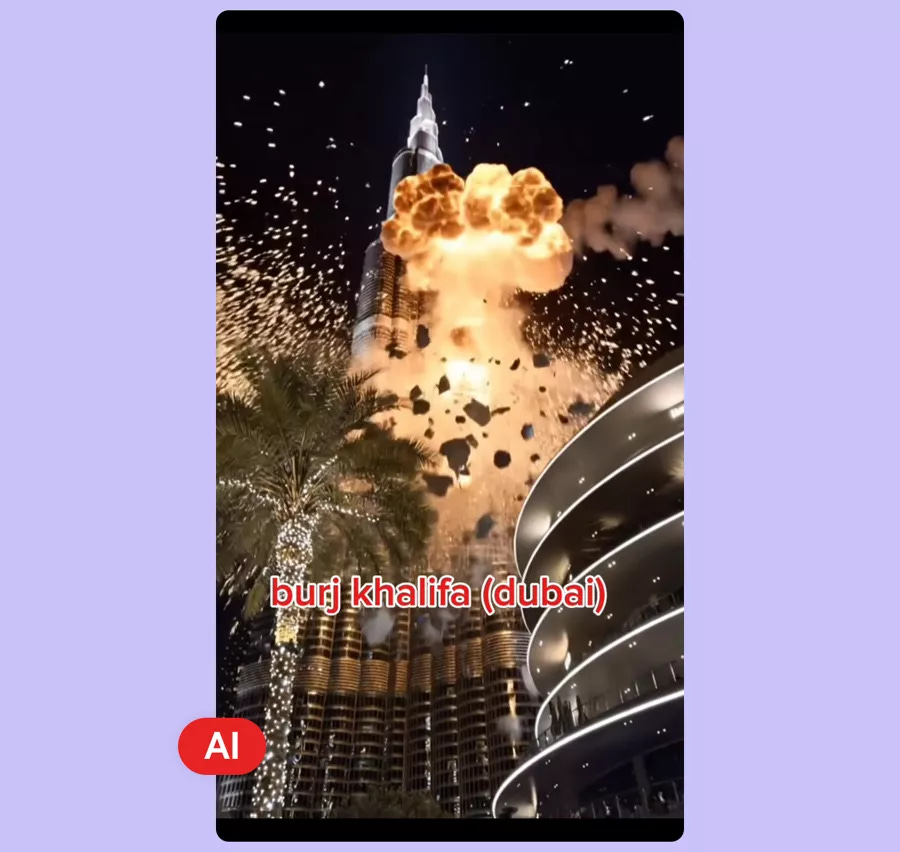
For VRT nws, Bram Vandendriessche unpicked the web of videos. A terminal at Dubai airport was indeed struck, but some images were fake. A dramatic video of a rocket hitting the Burj Khalifa and causing a massive explosion was created using AI — “and clearly a slightly older AI model”, Vandendriessche writes. “The debris and smoke plume look like something out of a cartoon, and every element in the video is less detailed than in reality.” Adding to the confusion, there were also real videos circulating showing smoke near the skyscraper.
Eyewitness information coming out of the United Arab Emirates about the situation on the ground was unhelpful in quelling the confusion. We already knew that Dubai, which is a hotspot for influencers, had been affected by explosions, and tourists were sheltering in the parking garages of hotels due to nearby blasts. European governments were also arranging evacuation flights for citizens, illustrating the gravity of the situation.
Despite this, many Dubai influencers appeared to be posting the same message: that Dubai is safe and that people feel even safer there than they would at home in Europe. DW News covered the story, including the questions from outsiders about whether influencers were being paid for spreading a coordinated message.
Some well-known Germans were also posting to say that they had deleted material because they weren’t sure what they were ‘allowed’ to post. The UAE has strict rules on what people can publish on social media, and influencers in Dubai “must also follow strict content rules” and avoid posting content that could harm public order or the reputation of the state.
OSINT analysis shows war quickly expanding
After the initial strikes in Iran, the conflict quickly ballooned across the entire region. Amid fake videos and a difficulty in ascertaining the true impact, OSINT analysts were able to identify some of the early impacts, like a slowdown in oil tanker movements around the Strait of Hormuz and airspaces closing around the Middle East.
For RTÉ Clarity, Kate McDonald analysed satellite imagery released by Vantor which showed fresh damage linked to the escalating conflict. Images captured on March 2 showed damage at Iran’s Natanz nuclear facility, at drone facilities in western Iran, at Zahedan airbase in Iran, and at the Ras Tanura oil refinery in Saudi Arabia, among others.
With the true scale of the impact yet to be revealed, OSINT analysis is one of the most reliable ways for the outside world to understand how this war is unfolding, and what areas may be coming into focus as the conflict develops.