

A joint investigation by European public service broadcasters has uncovered systematic manipulation of news comment sections on Instagram and Facebook — spanning bot-driven hate speech, political campaigns, and commercial spam. Across at least 17.5 million comments left in the 12 months between April 2025 and March 2026 on accounts run by European public media channels and programmes ORF, RTVE, RFI, LRT, Swissinfo, BR24, France 24, ARD’s Tagesschau and ZDFheute, one topic generated more coordinated inauthentic activity than any other: Iran.
Iran protest movement plays out in comment sections
As protests against the Islamic Republic of Iran intensified from January 2026, the comment sections of European public broadcasters reflected the country’s heightened political tension — with at least three distinct coordinated networks operating simultaneously on the same platforms, and sometimes beneath the same posts.
The largest single coordinated community identified across the entire dataset supported the Iranian opposition and its figurehead Reza Pahlavi, an exiled opposition figure and eldest son of the former Shah of Iran, Mohammad Reza Pahlavi. It generated tens of thousands of comments across the channels analysed, making it by far the highest-volume coordinated presence in the investigation. Accounts in this network posted using shared hashtags — #KingRezaPahlavi, #FreeIran, #IranRevolution2026, #DigitalBlackoutIran — and in many cases used near-identical template text, likely distributed through messaging app channels.
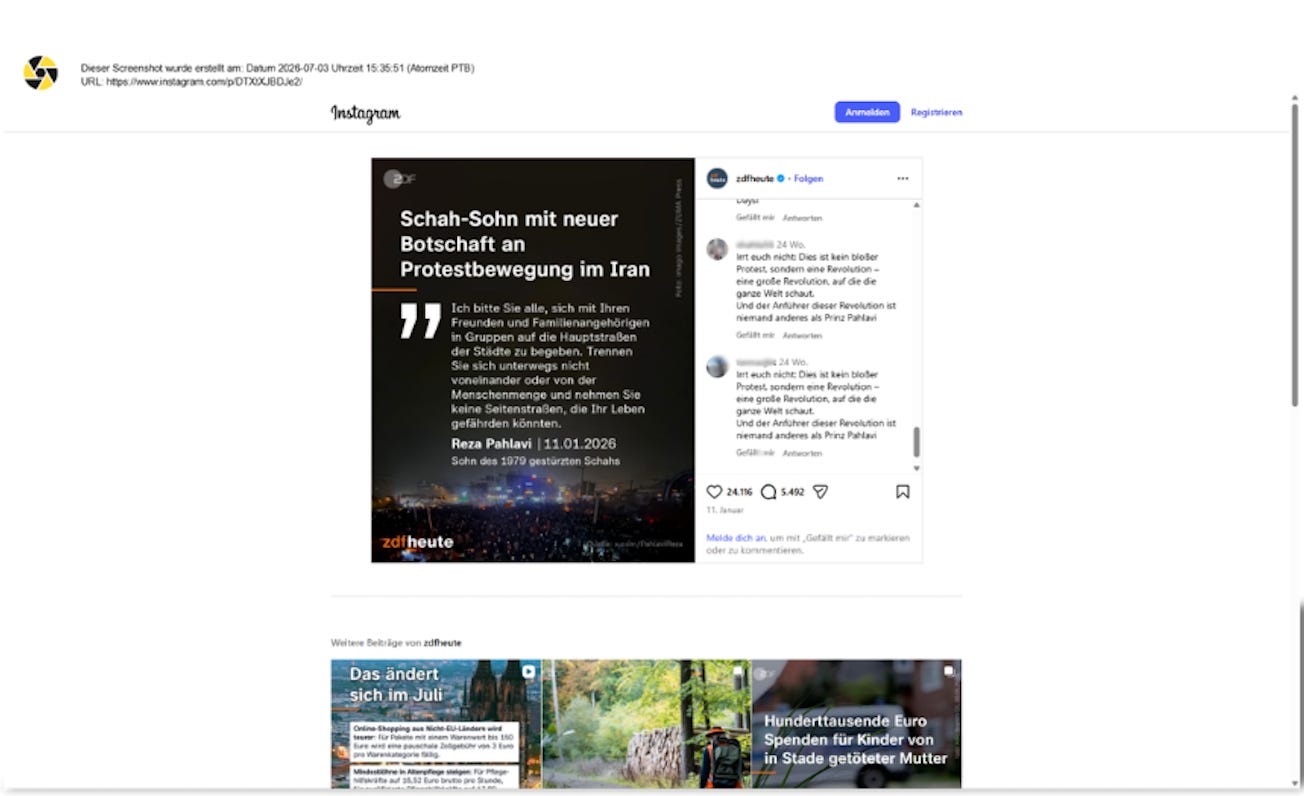
“Once again, the Islamic Republic has shut down the internet and phone lines, cutting people in Iran off from the world. Iranians abroad are deeply worried about the safety of our fellow citizens. Silencing a nation is not security it is hostage-taking. Be the voice of Iran.”
This text, with minimal variation, appeared hundreds of times across multiple comment sections — those of ORF, Tagesschau, France 24, RFI, RTVE and ZDFheute.
There was a telling forensic detail in comments across multiple participants of this investigation: a misspelled hashtag, #DigitalBlackoutlran, where a lowercase ‘l’ replaced the capital ‘I’ in ‘Iran’. This misspelled hashtag appeared identically in comment sections of ORF, ZDFheute, France 24, LRT and Tagesschau, and also in comments left on Belgian broadcaster RTBF’s page. ORF managed to also find traces of this hashtag on Telegram, but its true origin is unknown.
Similar pro-Pahlavi hashtags like ‘kingrezapahlavi’ and ‘iranrevolution2026’ were identified by Swissinfo, which found a series of accounts commenting on both its and BR24’s pages. These accounts changed their usernames relatively quickly, within the two-week interval during data collection in April. In May, as the journalists analysed the results of the data collection, Swissinfo observed that some posts from these accounts had been deleted by the accounts’ owners.
ORF, Tagesschau, France 24, LRT, RTVE, Swissinfo and BR24 all found versions of a pro-Reza Pahlavi network on their accounts. Most assessed the majority of accounts as likely belonging to real members of the Iranian diaspora engaged in genuine — if coordinated — political advocacy. Tagesschau also identified what appeared to be a separate, more clearly automated layer within the pro-Pahlavi activity: posts published within minutes of each other, almost all containing the exact words ‘King Reza Pahlavi’, pointing to bot amplification running alongside authentic human engagement.
In an interview with ORF, Alberto Fittarelli, an expert in cybersecurity, disinformation and OSINT at the University of Toronto, confirmed that the pro-Pahlavi movement online is largely led by real people. However, it appears to also be supported by two other types of online activities: “Accounts that are clearly bots or automated, pushing high volumes of content in short spans of time reacting to events,” Fittarelli said, and a “gray area that often consists of probably real accounts that are highly coordinated across different platforms.”
Pro-Iranian regime bot network
Running in parallel, and targeting the same posts, was a network promoting the other side: supporting the Iranian government and opposing the protesters. This narrative was clearly identifiable in Tagesschau’s comments, and its behaviour was among the most unambiguously inauthentic found in this investigation.
Network analysis shows a cluster operating with near-perfect internal connectivity — a network in which virtually every account was connected to every other. The comment data shows more than 200 accounts posted the following phrase, all on January 24. Most of the comments — more than 190 — dropped within a one-minute period, while the remaining ones trickled in within just over two minutes.
”Hopefully every demonstrator in Iran will be harshly punished. Iran will remain Islamic and there is nothing you can do about it.”
A second stream of accounts, operating under the same post, posted ‘Befreit den Iran vom Zionismus’ (Free Iran from Zionism). Those comments began appearing on the same day, just minutes before the earlier example, in a number of short bursts.
Account profiles showed patterns consistent with the work of commercial engagement-farming services: recently created, minimal posting history, and indicators suggesting a location in India — matching the profile identified in a similar spam operation previously uncovered by BR24 in a separate context.
It must be noted that for much of the January protest movement, the internet was almost entirely shut down across Iran, which would have affected any coordinated activity coming from within the country at that time. This investigation did not determine who was behind the varied coordinated messages, inauthentic or otherwise.
Hidden within the Iran debate: Comments inciting violence
The network data surfaced another cluster of comments linked to the Iran topic that is even more serious in terms of its content, and which came days after the beginning of the U.S.-Israeli war on Iran.
On the Instagram pages for Tagesschau and ZDFheute, a coordinated bot network posted identical text calling on Muslims worldwide to take violent revenge against the West and against Zionists, framing the conflict in Iran as part of a global war against Islam.
Dozens of accounts posted the identical message on the same day, March 2, in the comment sections of both broadcasters. The ZDFheute post had a total of 414 comments beneath it, 153 of which contained this identical call to violence. More than 50 such comments appeared under one Tagesschau post.
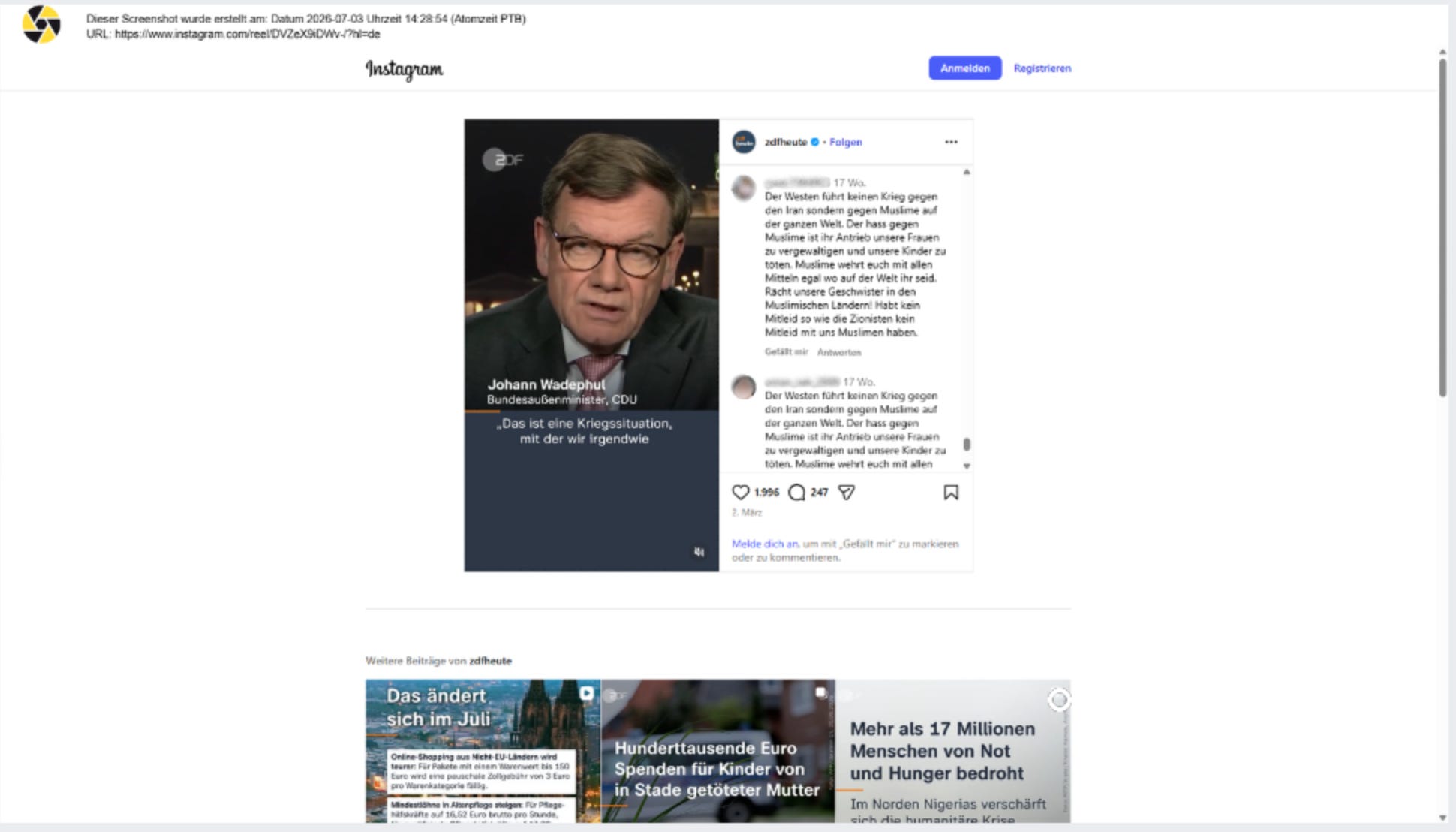
While the comments targeting Tagesschau and ZDFheute appeared at different times, each batch saw the large majority of identical comments posted within a minute. The account names also showed patterns consistent with auto-generated profiles.
“The West is not waging war against Iran, but against Muslims worldwide. Their hatred of Muslims is what drives them to rape our women and kill our children. Muslims, defend yourselves with all means at your disposal, wherever you are in the world. Avenge our brothers and sisters in Muslim countries! Show no pity, just as the Zionists show no pity for us Muslims.”
Among all the networks identified in this investigation, it ranked second in terms of how closely its accounts were linked to one another. It bore the hallmarks of a known type of manipulation campaign — and its simultaneous appearance on two major German-language broadcasters suggests one actor may have been behind it.
This finding — coordinated incitement to violence, pushed through bot infrastructure simultaneously across multiple public broadcaster platforms — represents the gravest category of activity identified in this investigation.
Other findings: Antisemitism, the Cambodia-Thailand border conflict, and financial scams
Beyond Iran, the investigation found further evidence of coordinated manipulation. On ORF’s Zeitimbild Instagram account, a bot network of more than 180 accounts began with criticism of Israel’s military actions in Gaza before escalating, over several weeks, to antisemitic hate speech that is categorised as illegal under Austrian law. By tracking the bots to other Instagram accounts where they were commenting, ORF managed to make contact with an influencer who had purchased comments for their own profile from a Turkish agency — giving more insight into the origins of the bot network. It remains unclear who commissioned the antisemitic content, and why this paid campaign ended up targeting a major news profile for Austria’s national broadcaster.
While most of this investigation looked at Instagram comments, some participants also dug into data from their broadcasters’ Facebook comments. France 24's Facebook account was targeted by a geopolitical campaign linked to the Cambodia-Thailand border conflict in July 2025.
Around 100 of the accounts used for this were created on the same day, approximately 1,000 of the 7,000 comments were posted at intervals of under five seconds, and the content attributed blame for the conflict to Thailand. Many of the accounts followed a page affiliated with Cambodia’s ruling party — though a direct link has not been established.
Several outlets also found financially-motivated networks. In Germany, BR24 and Tagesschau identified coordinated spam promoting online money-making schemes, with accounts bearing hallmarks of commercial engagement-farming services. ZDFheute found a network promoting social media growth services, and several participants found activity linked to the social media persona ‘richboyjames’, which spreads aspirational wealth content and ‘get rich quick’ schemes. The same activity was detected, in lower volumes, also by ORF. France 24’s Facebook comments included spam promoting pornographic channels, African faith healers and a purported AIDS treatment.
Lifting the curtain on a much larger system
Although this investigation looks only at the comments sections of public broadcasters, it offers a window into a much larger system operating in the online public sphere. The same tactics — bot networks, coordinated templates, fake accounts seeded from messaging platforms — are being deployed across the open internet to shape how ordinary people understand the world around them.
In some cases, like that of the incitement to violence comment, they could be classed as instruments of hybrid warfare: tools used to sow division, inflame tensions and radicalise audiences. An extreme comment from one source can suddenly appear as though it has the backing of thousands of ‘people’ in a manufactured debate, further manipulating the already deeply divisive landscape that is the open internet in the 2020s.
The comment sections of participating public broadcasters, analysed by internal teams aware of their own moderation systems, are an unusually transparent place to observe this activity.
But these news comment sections are simply one visible corner of a much larger landscape. What happens elsewhere, out of sight, may well be on a far greater scale.
Footnotes
Dates of the collected data: April 1, 2025 to March 31, 2026
Blocked comments: Comment moderation systems already block some offensive or expletive content. In some cases, comments containing this type of content were not reflected in the dataset, because they were initially blocked from publication by the organisations’ safety features. For this reason, some of the identified trends may even be conservative.
Reporting by: Eva Wackenreuther (ORF), Marcel Katzlinger (ORF), Jonas Send (ORF), Max Gilbert (BR24), Michael Schlegel (BR24), Sophie Menner (BR24), Quang Pham (France 24), Ershad Alijani (France 24), Nathan Gallo (France 24), Jurga Bakaitė (LRT), Estefanía de Antonio (RTVE), María Escobar (RTVE), Borja Díaz-Merry (RTVE), Akiko Uehara (Swissinfo), Pascal Siggelkow (Tagesschau), Carla Reveland (Tagesschau), Jan Schneider (ZDFheute), Marco Bereth (ZDFheute), Nils Metzger (ZDFheute), Maria Flannery (EBU), Sara Badilini (EBU)