



Your weekly briefing on digital investigation, OSINT, and the information war.
⚡ The 30-second brief
The debunk: Forensic analysis confirms viral images of Zohran Mamdani and Mira Nair with Jeffrey Epstein are AI-generated deepfakes originally posted by a parody account.
New tech: A new AI-powered tool designed to detect and alert users to malicious, manipulated content across major social platforms.
The intelligence stack: Using Overpass Turbo to filter and find specific landmarks or infrastructure around the world.
🔦 In the Spotlight
Fact-check: The release of a new tranche of files related to convicted paedophile Jeffrey Epstein sparked an avalanche of social media discussion that brought with it plenty of misinformation. Fakes included images of a young Zohran Mamdani with his mother in the company of the financier, as well as doctored email screenshots purportedly between Elon Musk and Ghislaine Maxwell. BBC Verify tracked the story in its live coverage.
Monitoring: We covered the rising tensions between the U.S. and Iran last week, but the situation ramped up further on Tuesday when the U.S. shot down an Iranian drone that it said was approaching the USS Abraham Lincoln in the Arabian Sea. See our OSINT guide for tips on how to follow this story.
🖋️ The Lead: AI-generated images fabricate Epstein connection
In the wake of the latest release of Jeffrey Epstein documents, viral images surfaced appearing to show New York City Mayor Zohran Mamdani and his mother, director Mira Nair, alongside Epstein. However, forensic analysis by VRT NWS, BBC Verify, and France24 confirmed these images are AI-generated deepfakes.
Key Findings
Source of disinformation: The images feature a “DFF” watermark, traced to the X account @DumbFckFinder, a self-described parody profile that shares AI memes. Despite their satirical origin, the images are being weaponized by political opponents. (VRT)
Technical verification: Using Google’s tool confirmed that the images were generated using its AI models. No authentic photographs of Mamdani or Nair with Epstein exist in the official case files. (Shayan Sardarizadeh)
The grain of truth: Mira Nair’s name appears only once in the millions of released pages—not as a co-conspirator, but in a 2009 email regarding a film afterparty for Amelia. There is no evidence of a personal relationship or meeting. (France 24)
Epstein file resources
📍Epstein Library | United States Department of Justice: The website is a repository of millions of documents, images, and videos collected by the FBI and DOJ over decades of investigations.
📍FBI Records: The Vault — Jeffrey Epstein: A repository of declassified and released documents concerning Jeffrey Epstein.
📍Jmail: A website simulating the user interface of Jeffrey Epstein’s inbox and Drive in a searchable format.
— Maria and Derek
⚙️ The intelligence stack
🔍 Overpass turbo
While many journalists use basic satellite imagery, Overpass Turbo allows for a "query-based" approach to geolocation that is essential for verifying footage from conflict zones or remote areas where landmarks are sparse.
Instead of manually scanning Google Earth, you can use a simple script to find the exact intersection of specific features (e.g., a “mosque” within 100 meters of a “pharmacy” and a “school”).
How to use it:
Go to overpass-turbo.eu.
Type a query like:
/*
This query looks for surveillance cameras
within 50m of a supermarket.
*/
[out:json][timeout:25];

// 1. Find all supermarkets in the current map view
node["shop"="supermarket"]({{bbox}})->.supermarkets;

// 2. Find surveillance cameras near those supermarkets
node(around.supermarkets:50)["man_made"="surveillance"]->.cameras;

// 3. Output the results
(.cameras;);
out body;
>;
out skel qt;
This script searches for all surveillance cameras (man_made=surveillance) located within 50 meters of a supermarket (shop=supermarket). This is highly effective for locating potential CCTV sources for a specific incident.
Zoom into your target city and hit Run.
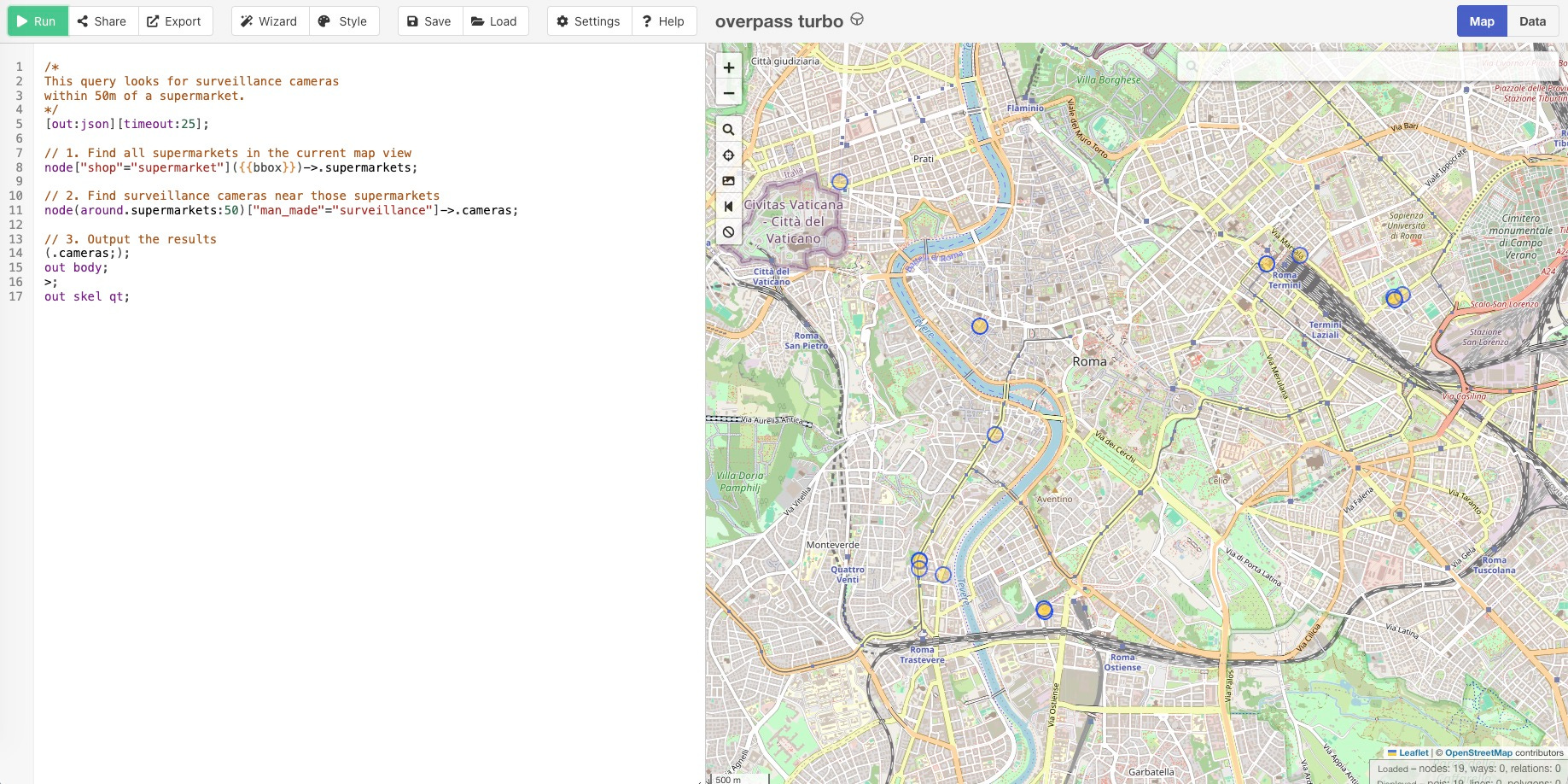
💡 Quick tip: If you find the manual Overpass QL code too cumbersome to write, the Wizard is your best friend. The Wizard translates “human-readable” terms into functional queries so you don’t have to worry about brackets or semicolons.
📍GEOINT: Learn how to turn satellite imagery into an empirical audit trail (Eurovision News Spotlight)
📍Satellite metadata: An OpenC3 COSMOS plugin for tracking satellites using the KeepTrack Space API. This plugin provides real-time satellite position tracking and orbital element data. (Clay Genki Kramp)
📍Temporal Analysis Engine: Extract and visualize temporal metadata from any URL. Discover creation dates, modification history, and hidden timestamps. (Roelof T.)
📍Company OSINT: The Coalition of Cyber Investigators discuss some of the ways that OSINT can help manage the risk of blind spots when you have operations in less mature markets. (Coalition of Cyber Investigators)
📍Deepfake Guard: New AI-powered tool designed to detect and alert users to malicious, manipulated content across major social platforms (Avast)
📍OSINT at home: 6 free satellite imagery tools every investigator should know (Benjamin Strick)
📍U.S. Armada: An OSINT intelligence guide to the naval build-up near Iran (Eurovision News Spotlight)
📍Reconya: Real-time network device discovery and monitoring (OSINTech)
📡 Signal analysis
In the 15th edition of the Spotlight Review, EBU members joined Maria Flannery to discuss the long-running problem of scam advertisements running on Facebook and the difficulties in verifying content from Iran’s recent protest movement.
Tim Verheyden (VRT) discussed a recent documentary that aired on the Belgian broadcaster’s investigative Pano programme, detailing a Europe-wide problem of industrialised scamming that has seen victims lose out on hundreds of thousands of euro.
Eva Wackenreuther (ORF) detailed how their investigation began in Austria after one of their newscasters was the subject of a deepfake ad on Facebook.
Before we go…
AI unlocks hundreds of cosmic anomalies in Hubble archive
Astronomers using an AI-assisted tool called AnomalyMatch discovered a "hamburger-shaped" planet-forming disk in the Hubble Archive. It's a classic example of automated anomaly detection surfacing something humans missed for 35 years because we weren't looking for "fast food" in deep space.