


On July 30, more than 60,000 people crossed from Morocco into Ceuta within roughly a 24-hour period — almost doubling the population of Spain’s North African exclave. Most of them were reported to have returned to Morocco in the following days; the Spanish government said they left voluntarily after facing a humanitarian crisis on arrival.
A week on, confusion still reigned in the information sphere about what caused the mass rush on the border. Accusations have come from across the spectrum: from political leaders to known conspiracy theorists, and all manner of social media users in between.
Some of the narratives have included questions like: Did Morocco or any other states have a hand in encouraging the border crossings? Did human trafficking gangs warp recent legal changes in Spain to boost their businesses? And should European countries begin closing their borders to stop any spillover from Spain?
The answers to all of these questions are not yet clear. Meanwhile, the facts and additional context that we do have risk being lost in the milieu.
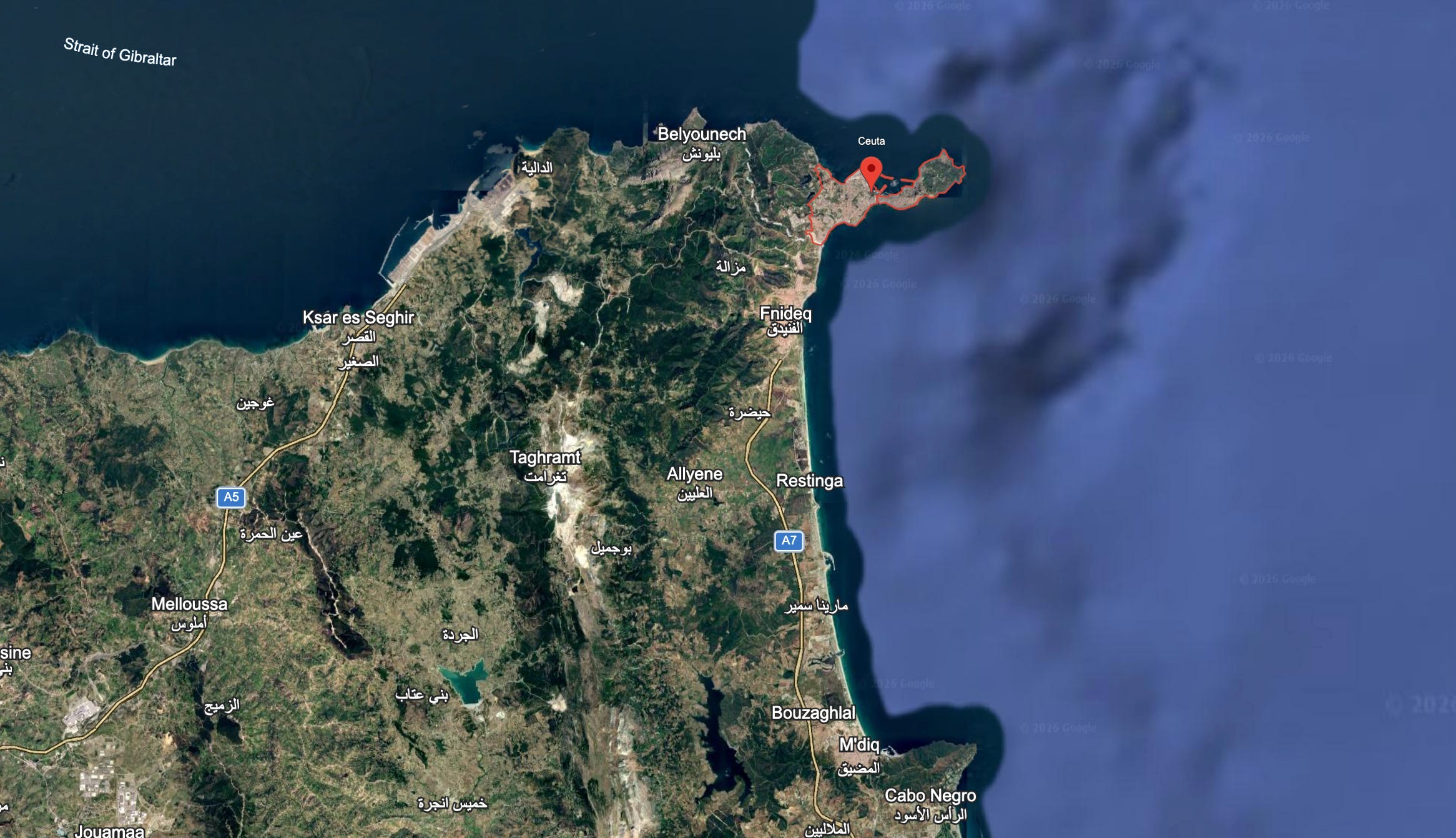
Local officials in Ceuta put the number of deaths during the crossings at more than 100. Ceuta’s leader Juan Jesús Vivas said that there were still between 3,000 and 5,000 migrants in the autonomous city a week later.
The crisis also triggered a political storm. An emergency EU ministerial meeting was held on August 4, which seemed to calm the tensions that had earlier been heightened between EU countries on how to handle the situation.
Misinformed readings of court rulings
Some coverage on a recent Spanish court ruling blends several separate legal developments together, muddying the waters of this already complicated topic.
Swimming to Ceuta
The first was a line of case law confirmed by Spain’s Supreme Court on June 29. It concerned a case from several years ago, in which an Algerian man challenged his return to Morocco, arguing that he had entered Ceuta by swimming. The Supreme Court ruled in his favour, establishing a precedent that migrants who arrive by swimming do not “cross a border containment element” (like a fence). The crossing of a fence or wire is technically a legal requirement for carrying out returns without due process; if not summarily returned, a case file can be opened and it would give a migrant more time to fight for their right to remain.
However, swimming to Ceuta is not a legal loophole that allows the swimmer to remain. Rather, it’s a technicality in how border authorities can handle such arrivals. When a migrant comes over a fence, the authorities are able to push them straight back over the border in a practice known as ‘hot returns’ — not possible in the same way for someone arriving by swimming, although they may still be removed after a short process. The recent ruling merely exposed this procedural gap.
Spanish officials and political leaders, including Prime Minister Pedro Sánchez, blamed trafficking gangs for warping the ruling and spreading misinformation about people’s chances if they were to swim into Ceuta. On a visit to Ceuta, Sánchez said: “What has emerged from our talks with Moroccan authorities is that trafficking mafias took a self-serving interpretation of a Supreme Court ruling”, adding that this interpretation “spread like wildfire”.
Unaccompanied minors
The second recent development, from July 8, saw the Supreme Court striking down parts of Spain’s 2024 immigration regulations. This one specifically relates to unaccompanied minors, strengthening authorities’ duty to provide care to those children found in Spain. Children and teenagers were among the crowds that crossed into Ceuta in late July, and more than 1,300 unaccompanied minors were still there a week later, according to the Minister for Youth and Children, Sira Rego.
Amnesty for people without residency permits
There is also another legal change underway; Spain is carrying out an amnesty programme to regularise immigrants without residency permits, but it only applies to those who arrived before January 1, 2026, and can prove they have been living there for at least five months.
U.S. President Donald Trump was among those to say that the various law changes sent a message that Spain is lenient, thereby sparking the rush to the border. He used the issue for his own political campaigning ahead of the U.S. Midterm elections. “If we’re not in office, our country will be invaded at levels that made Spain look small-time,” he said.
Did misinformation about the court rulings cause the crisis?
The question is whether the legal confusion contributed to Spain’s border crisis.
People have long tried to swim to Ceuta, and the Spanish city has seen people arriving on its beaches for years, although not in such huge numbers. UN data analysed by BBC Verify showed that 2,826 people crossed into Ceuta up to July 15 of this year — already high compared to recent years as Moroccans struggled with unemployment and staged anti-government protests.
Specifically timed surges of arrivals happened during a previous border incident in 2021, which was prompted by a diplomatic crisis relating to Spain’s hospitalisation of the leader of Polisario Front, a liberation group that opposes the Moroccan occupation of the Western Sahara, a former Spanish colony.
Separately, swimming crossings have also taken place at Melilla, Spain’s other North African enclave that is also surrounded by Morocco.
The timeline of these rulings, weeks before any major activity at the border, did not immediately suggest that they were the direct cause of the thousands of late-July crossings, and there was no clear evidence of any inauthentic information campaign. But there were signs that later viral misinformation about the changes — specifically the ruling about swimming — was one of the more significant contributing factors.
Spanish investigative outlet Maldita found one disinformation chain message that was shared with the same wording hundreds of times, including by large accounts, on July 30, which said: “The Spanish Supreme Court: there will be no immediate expulsion of migrants who reach Ceuta and Melilla by swimming.” Other posts discussing the ruling in simplified language, becoming misinformation in the process, appeared in online conversation in Morocco throughout July, but surged at the end of the month just as thousands of people began their journey to Ceuta.
Theories that the crossings had state-backed coordination
Many of the conspiracy theories surrounding the mass border crossing have involved some elements of state-backed coordination or interference.
Fingers pointed at Israel and the U.S.
Some of these — like one that has Israel and/or the U.S. as organisers, which has been promoted by an official Iranian embassy account and is reportedly the preferred explanation of Chinese intelligence — are lacking publicly available evidence.
Among those who have promoted these Israel-related hypotheses are prominent conspiracy theorist Alex Jones and Gabriel Rufián, spokesperson of the Republican Left of Catalonia.
Both Donald Trump and Benjamin Netanyahu had recently criticised Spain’s positions on both the Palestine issue and also the countries’ war with Iran.
Israel’s ambassador to the UN, Danny Danon, posted on X as the crisis was underway, accusing Spain of hypocrisy for criticising Israel while it kept what he described as “colonial enclaves” in Africa.
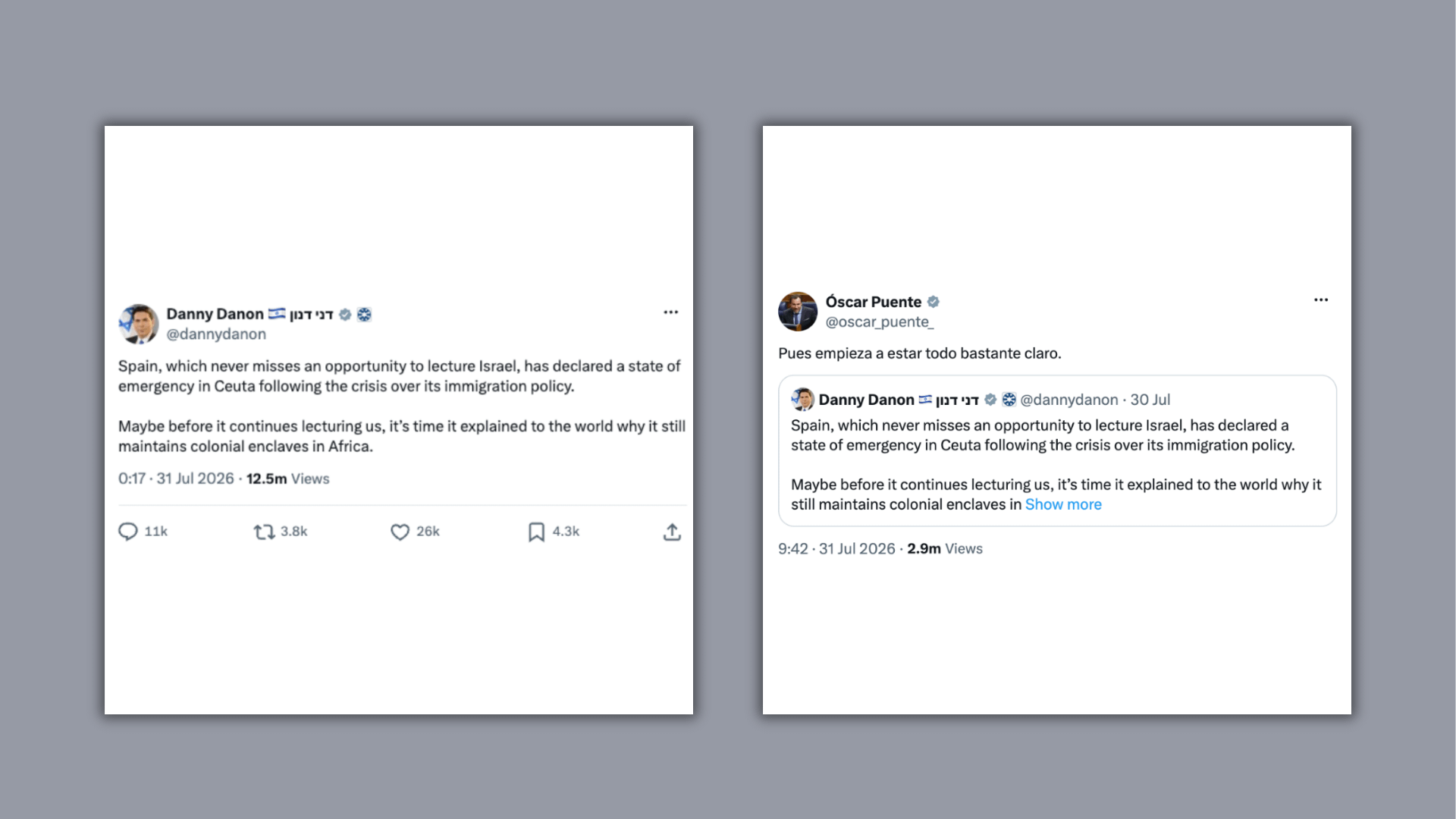
Spanish Transport Minister Óscar Puente responded to the post, writing: “Well, it’s all becoming quite clear.” Although not a direct accusation, this reply was read by many as one of the most clear endorsements of the theory early on in this story.
There is little out there for us to fact-check these foreign interference theories against; intelligence assessments suggesting international geopolitical interference have been slow to emerge, and there is no smoking gun in the available open-source information or eyewitness footage.
Morocco encouraging the surge?
There is more to suggest that the Moroccan authorities at least allowed the surge at the border to happen, even if they didn’t plan or directly encourage it. Verified social media footage showed Moroccan authorities standing by as people headed towards the border crossing. There is no public evidence that they outright encouraged or coordinated it, but there is content to suggest they did not physically stop it.
Spanish intelligence assessments, reported by local media which were later cited by Reuters, stated that border controls were gradually loosened throughout July and were ultimately at a low level on July 30, when Morocco celebrates its Throne Day holiday.
Among the reasons social media users gave as to why Morocco may have wanted to punish Spain was the recent visit to Algeria by Pedro Sánchez, a new law allowing tens of thousands of Sahrawis to become Spanish citizens, and even rivalry over the 2030 World Cup, which the countries are co-hosting along with Portugal.
An assessment by Spain’s National Intelligence Centre, reported on by Spanish newspaper El País on August 3, concluded that Moroccan authorities did not organise the crossing but did allow it to happen and later used it as diplomatic leverage.
Ceuta’s regional president, Juan Jesús Vivas, went further in publicly accusing Morocco of “encouraging and allowing” the mass border crossing. Morocco has emphatically denied any involvement, and there is no verified footage showing Moroccan authorities actively directing people towards the border.
Italy’s border checks despite non-Schengen Ceuta
In Italy, Giorgia Meloni’s government was one of the first to respond to the Spanish crisis, announcing “targeted and selective” checks on non-EU passengers arriving from its EU neighbour.
The change was reported as a temporary suspension of the Schengen free movement regime, since both Spain and Italy are in the Schengen area. Deputy Prime Minister and Minister for Foreign Affairs, Antonio Tajani, said in a statement on X: “The migrant crisis in Ceuta reminds us that the management of the Union’s borders is a shared responsibility among our countries, one toward the other. We must work together to prevent uncontrolled migrant flows from entering EU territory, with all the consequent risks and the threat of terrorism, which must be countered without hesitation.”
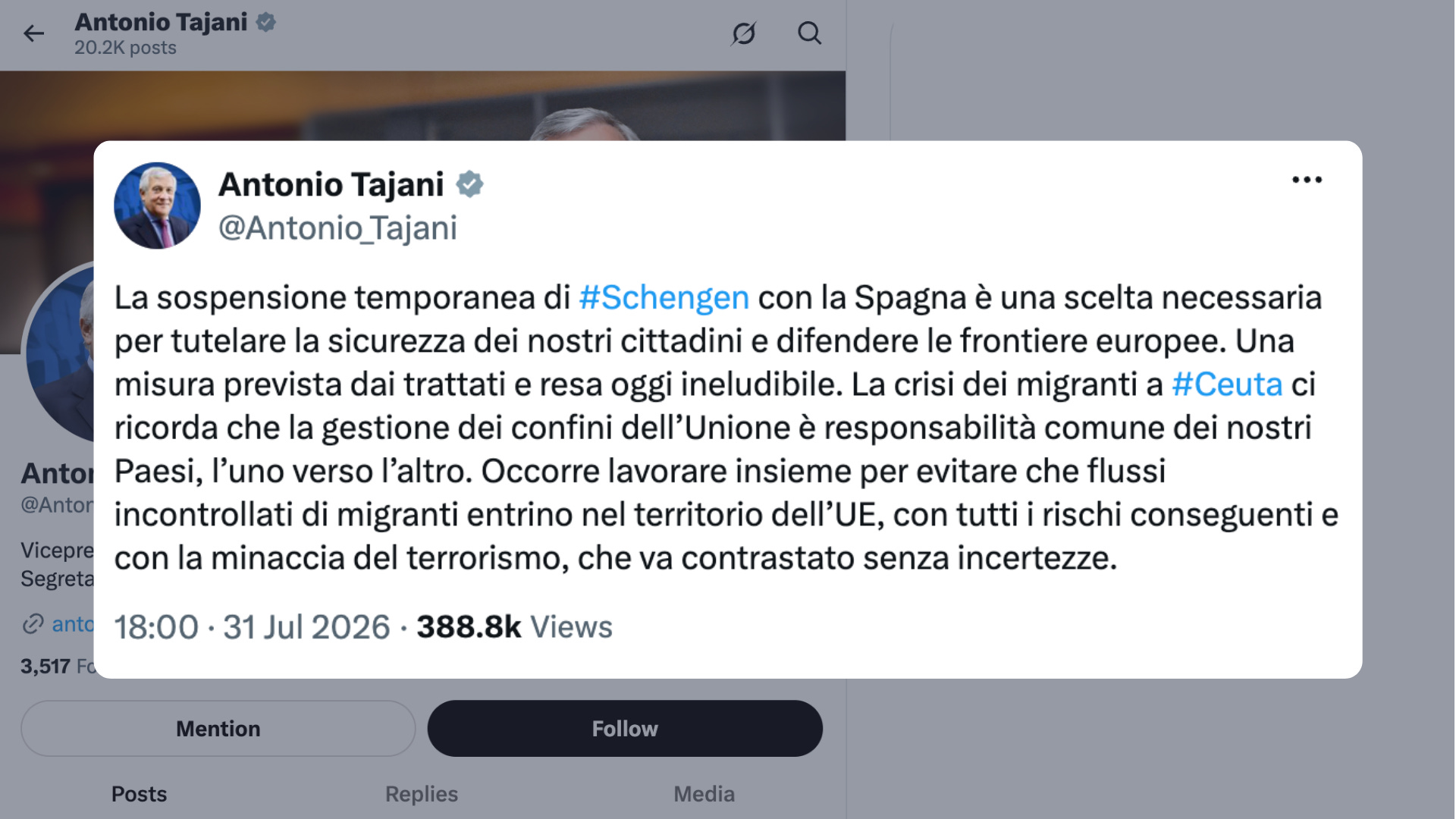
Prime Minister Giorgia Meloni said the move was aimed at defending Italy’s borders.
However, the measure has been described as symbolic or politically motivated. While Spain is in the Schengen zone, the autonomous Ceuta is not, meaning that anyone travelling from Ceuta to mainland Spain would already be subject to passport and visa checks.
Spain’s Interior Minister Fernando Grande-Marlaska said that the surge of migrants into Ceuta did not “compromise” Europe’s visa-free travel zone, a point which he later told reporters was agreed among his EU counterparts after the August emergency meeting.
Italy was not the only country to call for a review of Spain in the free-travel area; Denmark had also earlier advocated for a suspension, but its Immigration and Integration Minister Morten Bodskov said this week that he was “very satisfied” by the response from Madrid.
Despite the fact that the location of the migrant crossings was not in the Schengen zone and therefore the people would be subject to checks upon further movement into the zone, Italy was still treating travellers from Spain as non-Schengen area arrivals as of the time of writing.
Evidence of planning for more border crossings
Open-source research by Spotlight member VerificaRTVE showed that fresh plans for a rush on the Ceuta border on August 15 were afoot. Messages circulating in advice channels for would-be migrants showed clear evidence of misinformation fanning the trend; one message read: “Guys, I wanted to ask you: is it true that the border will be open on August 15th?”
RTVE accessed three WhatsApp groups, five Facebook communities, and monitored messaging circulating on dozens of Instagram and TikTok accounts relating to this new call to enter Spain in mid-August.
The Facebook groups had more than 200,000 members, while hundreds of people were in closed messaging groups on WhatsApp where they shared thousands of messages, discussing when and how to cross, advice on swimming equipment and meeting points, and often sharing unverified information.
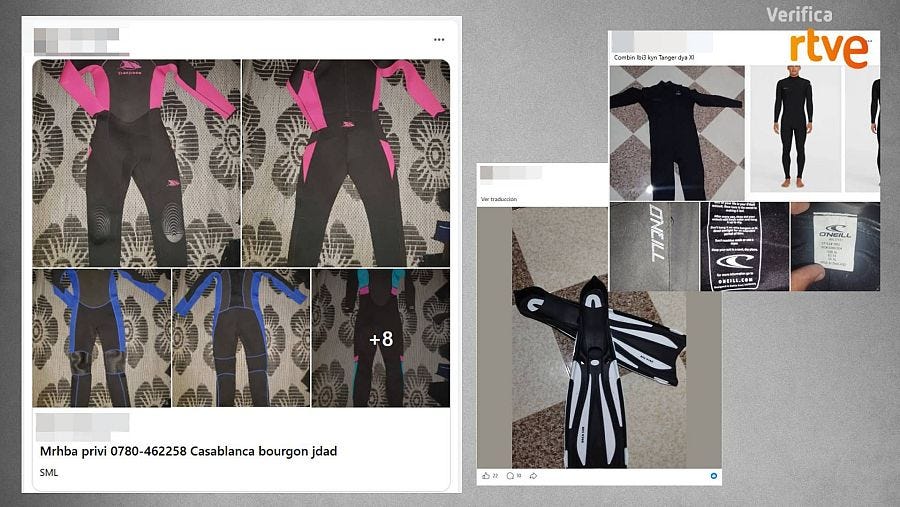
On public platforms, the tone was one of outreach, with the apparent aim to find more participants with hashtags like #ceuta, #fnideq and #europe.
RTVE found one slogan that came up again and again: “That day everything will make sense.” Spain’s Civil Guard is already investigating this fresh call to action, and journalists are monitoring the situation as the date approaches.
Sources
Associated Press (2026). FACT FOCUS: Migrant crossing in Spain’s Ceuta breeds unsubstantiated claims. [online] [Accessed 6 Aug. 2026].
BBC News (2026). Spain’s PM blames traffickers after 60,000 migrants reach Ceuta from Morocco. [online] [Accessed 6 Aug. 2026].
CNN (2026). The Supreme Court ruling at the center of Spain’s Ceuta migrant crisis. [online] [Accessed 6 Aug. 2026].
Danon, D. (2026). X post questioning Spain’s criticism of Israel in light of its own African enclaves. [online] [Accessed 6 Aug. 2026].
El País (2026). Los servicios de inteligencia concluyen que Rabat permitió y utilizó la oleada humana sobre Ceuta, pero no la planeó. [online] [Accessed 6 Aug. 2026].
El Mundo (2026). Por qué la inteligencia china cree que el Mosad puede estar detrás de la crisis migratoria en Ceuta. [online] [Accessed 6 Aug. 2026].
Embassy of Iran in Kenya (2026). X post alleging the Ceuta crisis was orchestrated by external actors to destabilise Spain. [online] [Accessed 6 Aug. 2026].
Euronews (2026). Spain’s legal dilemma behind Ceuta’s record migrant arrivals. [online] [Accessed 6 Aug. 2026].
Jones, A. (2026). X post suggesting the United States and Israel supported the movement of migrants into Spain. [online] [Accessed 6 Aug. 2026].
NBC News (2026). Spain’s Ceuta overwhelmed as thousands remain after migrant border rush. [online] [Accessed 6 Aug. 2026].
PBS News (2026). Most of the 60,000 migrants who crossed into territory of Ceuta have left voluntarily, Spain says. [online] [Accessed 6 Aug. 2026].
Puente, O. (2026). X post replying to Danny Danon, suggesting the situation was becoming clear. [online] [Accessed 6 Aug. 2026].
RTÉ (2026). EU ‘united with Spain’ over Ceuta crisis - O’Callaghan. [online] [Accessed 6 Aug. 2026].
RTVE (2026). Cientos de menores vagan por las calles de Ceuta una semana después de la entrada masiva en medio del debate político. [online] [Accessed 6 Aug. 2026].
RTVE (2026). Varias fechas, posibles rutas y consejos: la investigación de cómo se organiza en redes una nueva entrada en Ceuta. [online] [Accessed 6 Aug. 2026].
Rufián, G. (2026). X post accusing Morocco of acting on behalf of the US and Israel in the Ceuta crisis. [online] [Accessed 6 Aug. 2026].
Tajani, A. (2026). X post confirming Italy’s temporary suspension of the Schengen agreement with Spain over the Ceuta migrant crisis. [online] [Accessed 6 Aug. 2026].
UNHCR (2026). Situation Europe Sea Arrivals: Spain. [online] [Accessed 6 Aug. 2026].
RTVE (2026). Rego cifra en 1.342 los menores registrados en Ceuta y prevé que en “pocas semanas” empiecen a derivarse a la península. [online] [Accessed 6 Aug. 2026].