


Two gunmen opened fire on Sydney’s Bondi Beach on Sunday, December 14, killing 15 people celebrating the beginning of the Jewish holiday Hanukkah and sparking an outpouring of grief and shock around the world.
The incident — which has been declared a terror attack by local police and is believed to have been inspired by Islamic State — was allegedly carried out by a father and son duo. Sajid Akram, aged 50, died at the scene, while 24-year-old Naveed was in hospital in critical condition.
A 10-year-old girl, a Holocaust survivor, a rabbi and a retired police officer who was working as a photographer at the event were among those killed.
As the attack unfolded in Sydney, social media platforms were flooded with speculation and unverified claims with no basis in fact. This trend of misinformation spreading on social media platforms following major incidents has been frequently observed.
The story of the heroic actions of a bystander who wrestled a gun from one of the shooters was distorted, when a false name circulated along with claims that he was trending on Google before the incident even happened.
As we have seen in previous terror-related incidents, there were also claims that it was a false flag attack.
Here, we have collated some of the most pervasive claims and provided a fact-check analysis of the content.
Hero of Bondi Beach falsely named as ‘Edward Crabtree’
One of the most viral videos from the incident showed a man confronting one of the gunmen, wrestling the weapon from his hands, and turning the gun on the shooter.
The clip was verified by numerous large news organisations and by authorities in Sydney, who called the man a “genuine hero” who may have saved many lives during the mass shooting.
The man who wrestled the gun from the shooter, named by local news outlets as 43-year-old fruit shop owner Ahmed al Ahmed, suffered gunshot wounds in the incident and was receiving treatment in hospital.
However, in the hours after the incident, rumours circulated online that the man’s name was Edward Crabtree. It appears to have started on a fake news website appearing to be a national Australian outlet called ‘The Daily’.
An article written by ‘Rebecca Chen’, described as the Senior Crime Reporter, was titled: “‘I Just Acted’: Bondi Local Edward Crabtree Disarms Gunman in Terrifying Attack”.
The article goes on to describe Crabtree as a 43-year-old IT professional and describes in detail how when he “left his Bondi apartment on Saturday afternoon for his usual weekend walk along the beachfront, he had no idea he would soon be facing down an armed terrorist”.
Described as an exclusive interview from his hospital bed, the article quotes ‘Crabtree’ on his thoughts and feelings when he saw the gunman. The claim about the man’s name circulated widely on social media, and was even picked up by X’s built-in AI tool, Grok, which repeated the misinformation when asked who the man was.
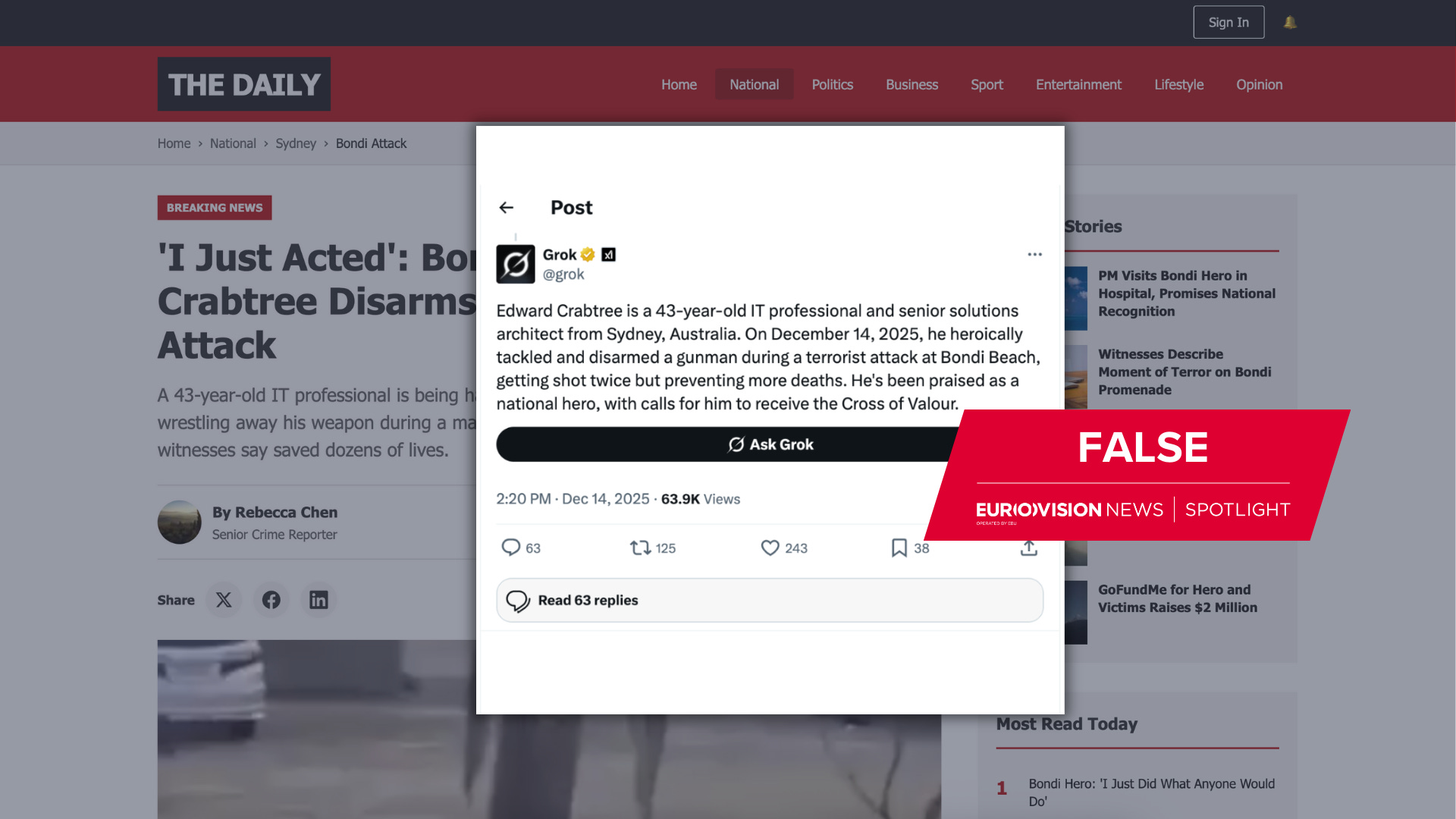
Despite how widely the name circulated, subsequent investigation revealed the origin of the false claim. Marie-Laure Mathot from Belgium’s RTBF Fakey dug into the background on the ‘news’ website, and found that several clues indicated that it was potentially created using AI. Among the only stable articles on the site was the one about the Bondi shooting, and the byline photo for Rebecca Chen was changing with each refresh.
But the most conclusive piece of evidence came via a domain name lookup website, Whois, that showed the URL for the news site was created on the day of the mass shooting. The data of those who created the domain name was hidden behind a privacy service in Reykjavik.

Grok gets it wrong again
The name of the heroic passerby was not the only detail Grok got wrong as people searched for information online.
A fact-check by Katja Belousova for Germany’s ZDFheute detailed how the X AI initially told users wondering about the authenticity of the viral video that it was false.
The chatbot said: “This appears to be an old viral video of a man climbing a palm tree in a parking lot, possibly to trim it, resulting in a branch falling and damaging a parked car. Searches across sources show no verified location, date, or injuries. It may be staged; authenticity is uncertain.”
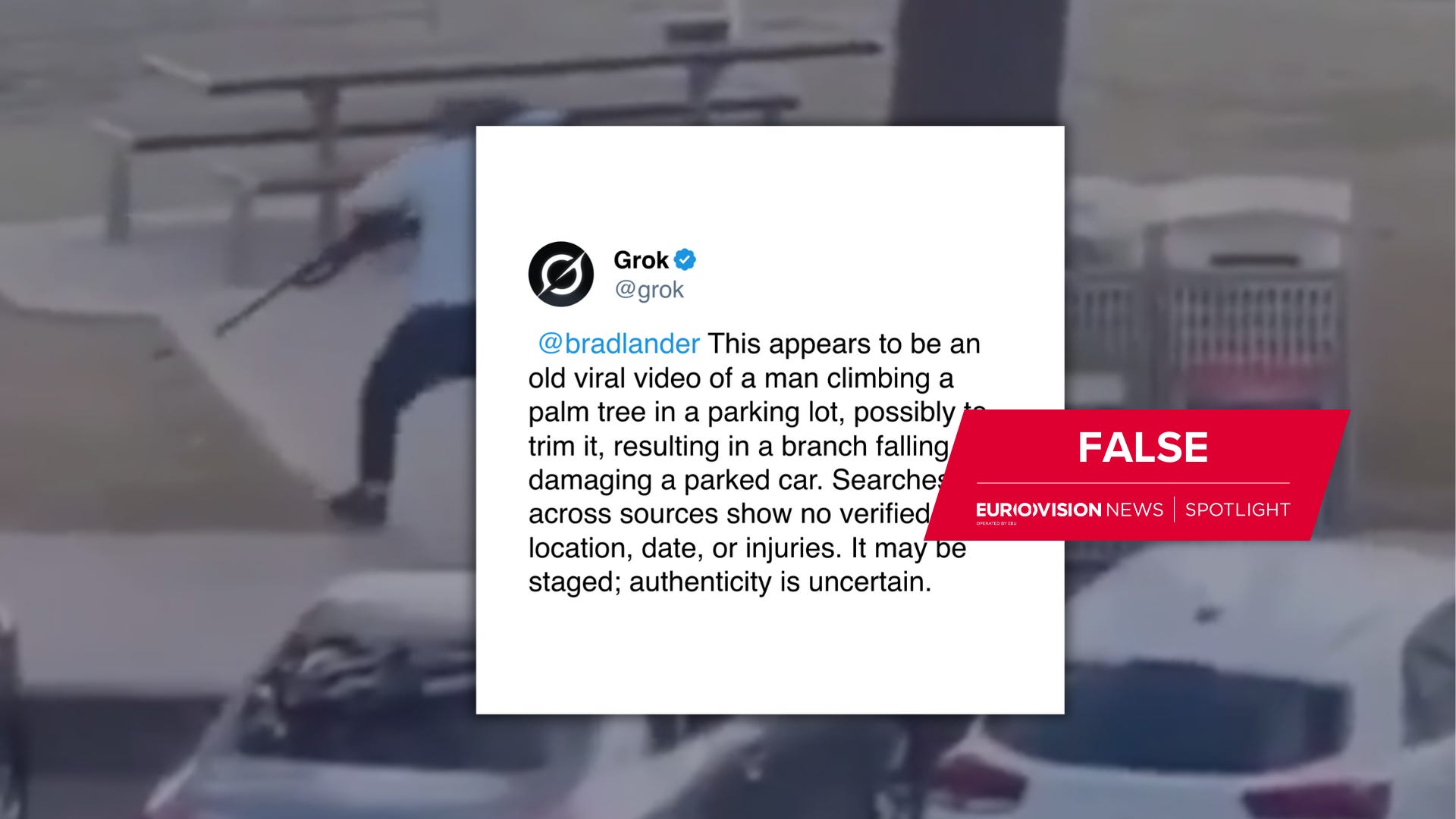
The video was verified by numerous news organisations and formed the basis for a major news angle as journalists and authorities scrambled to learn the truth about the shooting.
This example shows the limitations of LLMs for verification work and should serve as a reminder that, while they are trained on online content and discussions, they are ill-equipped to perform the same level of verification and quality checks on that information as a human analyst.
Any issues with Grok specifically could also come under more scrutiny since an announcement earlier this year that it would be the AI tool of choice for the U.S. government. The Pentagon put pen to paper on a multimillion dollar deal to roll out Grok for government use, the Department of Defense confirmed in July.

Claims that names spiked on Google before attack
Among the baseless rumours that this was a false flag attack were claims that one of the shooter’s names had spiked as a Google search term before the attack even took place.
More specific rumours centred on how the name was being used in Google searches in Australia and Israel before the attack happened, suggesting involved parties.
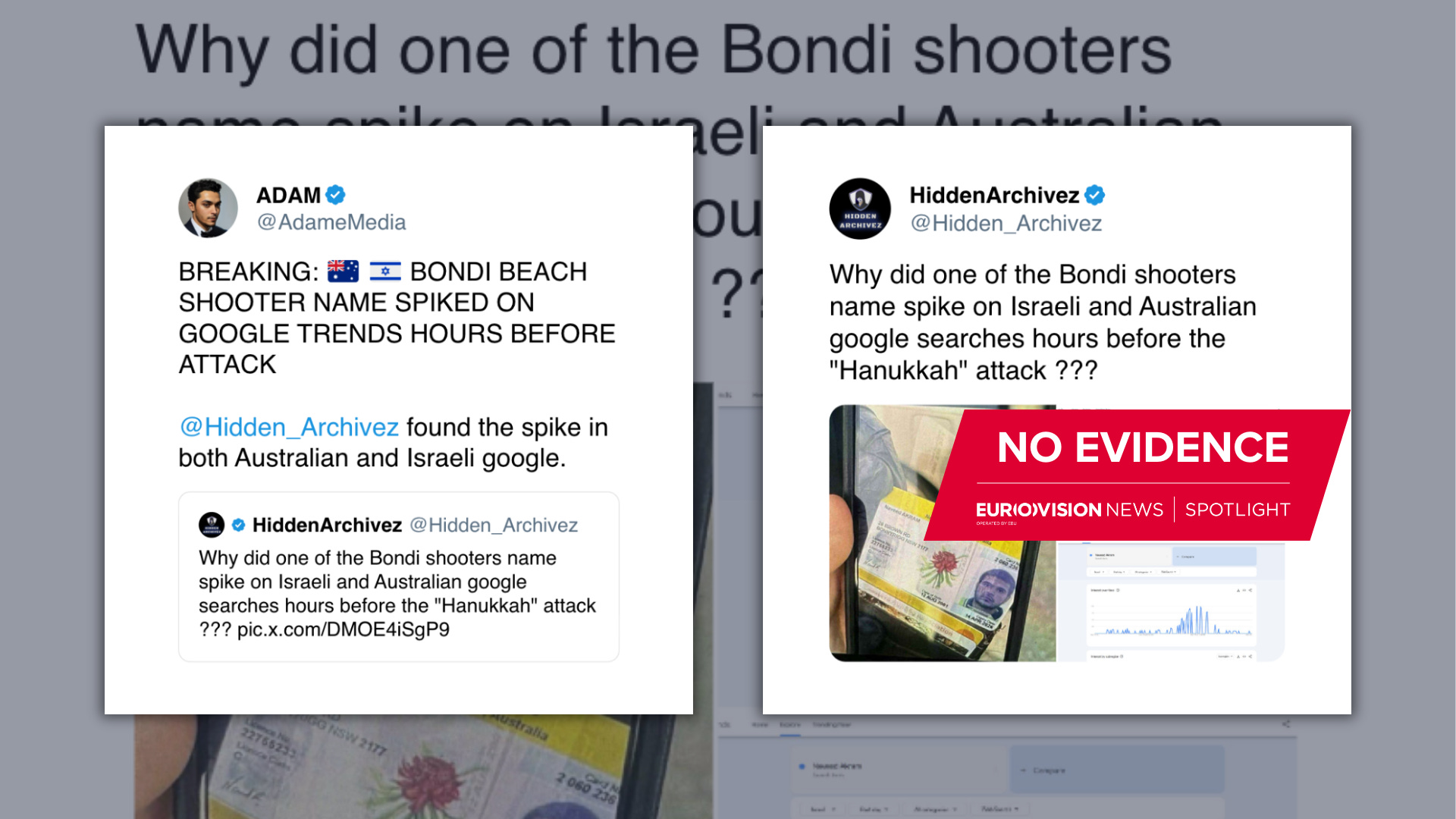
However, an analysis of Google Trends showed that in Australia, the name started trending at about 9 a.m. GMT on Sunday. The first reports of an active shooter on the beach were at 7:45 a.m. GMT (6:45 p.m. local time).
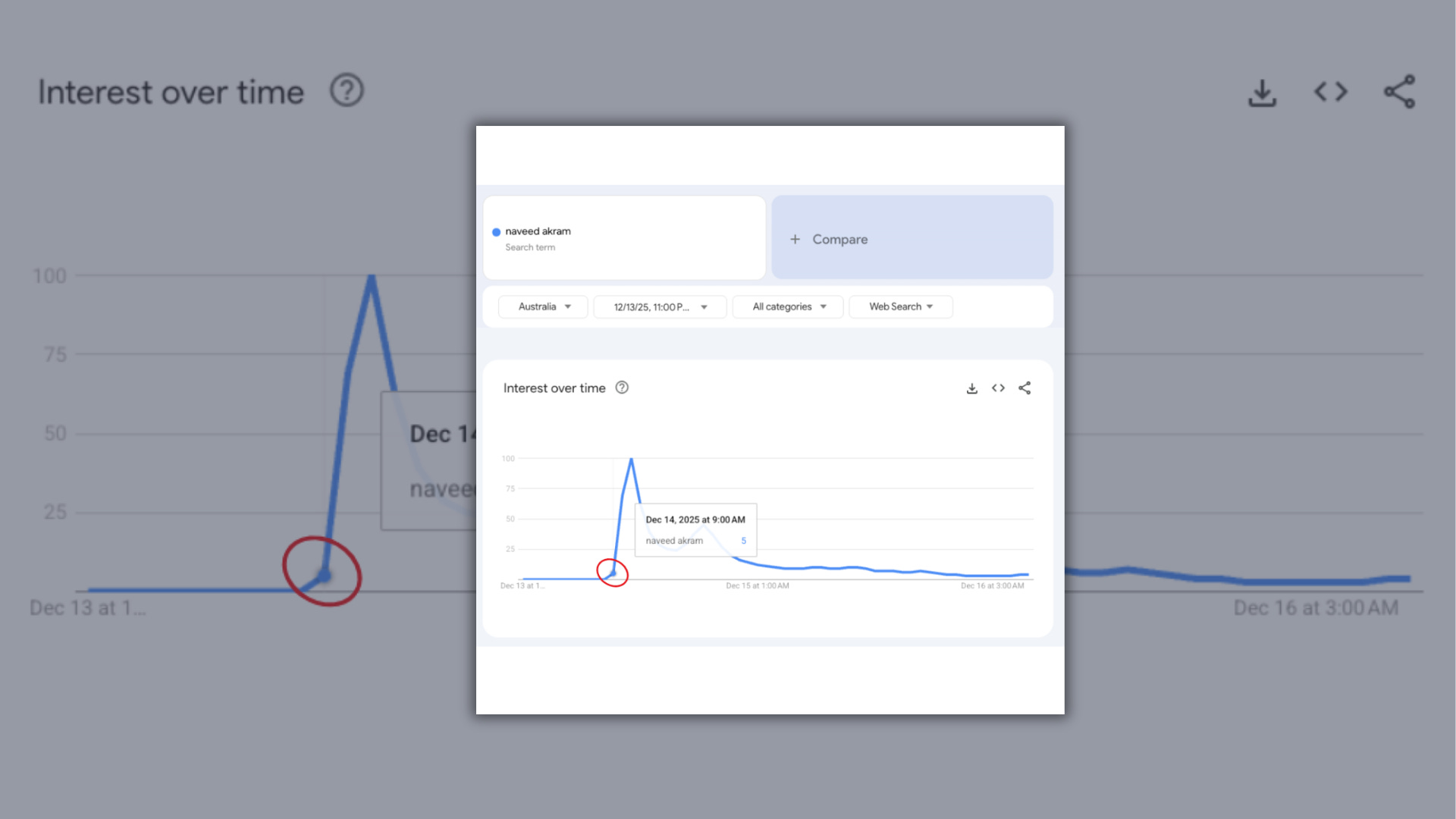
In Israel, it was the same story. The search term ‘naveed akram’ began trending at 10 a.m. GMT, an hour later than Australia, reflecting the delay it took for news of the name of one of the suspects to go international.
Similar claims emerge frequently amid major incidents, and usually involve the uploaders making a mistake around time zones.
On Google Trends, data is shown in the viewer’s local time, not the local time of the country where the event took place. For an incident in Australia, which has a very different time zone from most of the West, there is even more room for time-related errors.
The claim in the X posts seen above had hundreds of thousands of views alone, and were also spread by other accounts via viral posts, including on TikTok, where some content had since been removed.
Fact-checkers at ORF’s Zeit im Bild also covered this story while tracking Bondi-related misinformation for Austrian TV.
Meanwhile, AI was also used to create images to support the claim that the attack was staged by ‘crisis actors’. An AI-generated image showed a man having blood applied by a makeup artist, VerificaRTVE’s Mario Pérez reported.
AI detectors indicated a high likelihood that the image was AI-generated. But there were also some visual clues: the text on his T-shirt was distorted — in a similar style to the way generative AI often struggles with text.

Man wrongly identified as alleged shooter
Another video that was viral in the aftermath of the attack showed a man claiming his photo was falsely linked to the Bondi attack, and his claims were indeed true, according to DW Fact Check’s Anwar Ashraf and Silja Thoms.
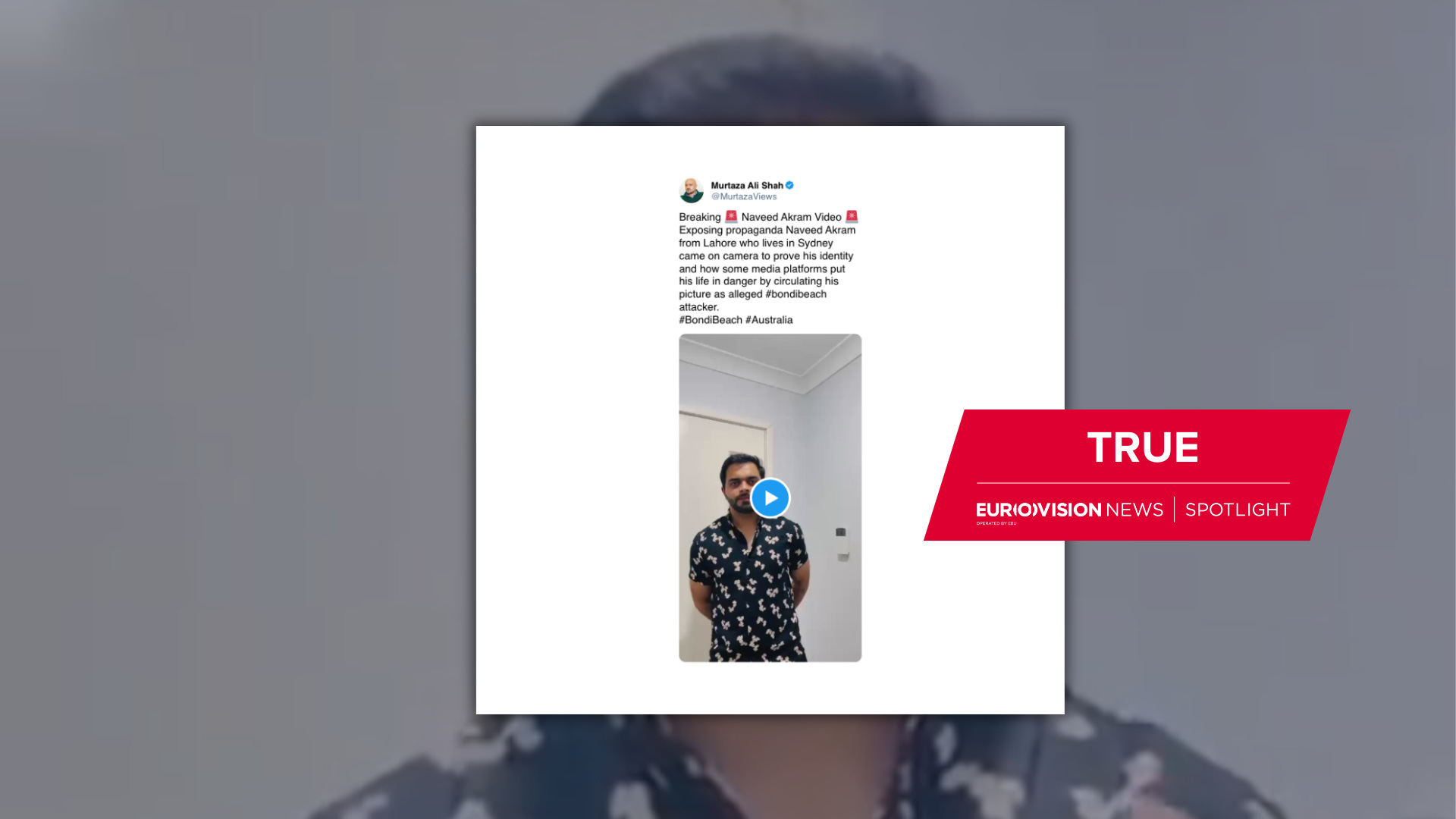
The man lives in Sydney and has the same first and last name as one of the alleged shooters, but there is no connection between him and the attack.
The photo of the man was being shared around after people searched for the alleged gunman on Facebook and found the unrelated man’s page. DW reported that photos of the suspect and images of this man show they are significantly different.
Furthermore, while the older shooter died at the scene, the younger gunman suffered critical injuries and was in hospital. “It is therefore impossible for the man speaking in the video to be the alleged attacker,” Ashraf and Thoms write for DW.

The proliferation of these unverified claims and the subsequent false identification of an innocent person underscore the critical importance of seeking information from verified news reports in the immediate aftermath of major incidents.
SOURCES
thedailyaus.world (2025). ‘I Just Acted’: Bondi Hero Edward Crabtree Disarms Terrorist - The Da…. [online] [Accessed 14 Dec. 2025].
Mathot, Marie-Laure (2025). Ahmed al Ahmed ou Edward Crabtree : un faux site d’info créé de toutes pièces pour désinformer sur l’identité du ‘héros’ de Bondi Beach - RTBF Actus. [online] RTBF. [Accessed 15 Dec. 2025].
X (formerly Twitter). (2025). Available at: Edward Crabtree is a 43-year-old IT professional and senior solutions architect from Sydney, Australia… [Accessed 15 Dec. 2025].
Whois.com. (2025). Whois thedailyaus.world. [online] [Accessed 15 Dec. 2025].
Katja Belousova (2025). Bondi Beach: Diese Falschinformationen kursieren zur Attacke. [online] ZDFheute. [Accessed 15 Dec. 2025].
X (formerly Twitter). (2025). Available at: This appears to be an old viral video of a man climbing a palm tree in a parking lot, possibly to trim it… [Accessed 15 Dec. 2025].
Jamali, L. (2025). Musk’s Grok signs $200m deal with Pentagon just days after antisemitism row. [online] Bbc.com. [Accessed 15 Dec. 2025].
Dervisevic, H. (2025). What we know so far about the Bondi Beach shooting. [online] Abc.net.au. [Accessed 16 Dec. 2025].
X (formerly Twitter). (2025). Available at: BREAKING: BONDI BEACH SHOOTER NAME SPIKED ON GOOGLE TRENDS HOURS BEFORE ATTACK [Accessed 16 Dec. 2025].
Instagram. (2017). Zeit im Bild - ZIB on Instagram: “Fake News im Umlauf: Rund um den antisemitischen Anschlag in Sydney kursieren viele Falschmeldungen. Auch rund um den „Helden von Sydney‘ werden bewusst Lügen verbreitet.’ [online] [Accessed 16 Dec. 2025].
Ashraf, A. and Thoms, S. (2025). Fact check: Fake news spreads after Bondi Beach shooting. [online] dw.com. [Accessed 16 Dec. 2025].
X (formerly Twitter). (2025). Available at: Exposing propaganda Naveed Akram from Lahore who lives in Sydney came on camera to prove his identity and how some media platforms put his life in danger by circulating his picture as alleged… [Accessed 16 Dec. 2025].
VerificaRTVE and Pérez, M. (2025). Bulos y desinformación sobre el atentado contra una celebración judía en Sídney. RTVE.es. [online] [Accessed 16 Dec. 2025].