



CLAIM: Discourse around a recent boycott of Spotify centered around the CEO’s investment in an arms company alleged to be used by Israel in Gaza.
BACKGROUND: A new artist boycott of Spotify was launched earlier this year after the CEO Daniel Ek’s investment company led a new round of funding for Helsing, a German defence technology company. Artists raised their opposition to their music funding lethal weapons while also mentioning their opposition to the ongoing war in Gaza, leading some to believe that Helsing’s tech was being directly used in the Middle East.
METHOD: Helsing released a statement saying its technology was only being used for the defence of Ukraine, and was not being exported to Israel. Spotify sought to clarify that Helsing is completely separate from it. Daniel Ek, who in recent years has become increasingly involved in his other business interests, announced he would step down as CEO of Spotify in the New Year.
RATING: The mixed messaging in some of the communications of the boycott led to an incorrect link being drawn between Helsing activities and Israel.

Spotify is currently facing an escalating wave of cancellations and an artist boycott, stemming from CEO Daniel Ek’s investments in the military technology company, Helsing.
While the boycott was fundamentally launched in opposition to Ek’s involvement in Helsing, the narrative surrounding the controversy has been complicated by the incorrect conflation of separate issues. Reports indicate that the timing and nature of certain activist communications allowed a misleading link between Helsing and the conflict in the Middle East to gain traction.
And despite a clarification from the companies involved, the claims have persisted, spreading from Spotify’s base in Sweden across borders and reaching Spain, where activists threw red paint on an FC Barcelona shop over the football club’s Spotify sponsorship. Artists boycotting the music platform mentioned their activism against weapons funding and the war in Gaza in the same statements — contributing to a situation where both issues looked connected.
The complex nature of the links between each party in this story — some of which are openly disclosed and some of which are tenuous or even untrue — have helped the claims to persist, especially on social media where calls to action are communicated in short slides or 280-character posts.
So where does this story come from, and what is the truth behind the claims?
Daniel Ek and his investments
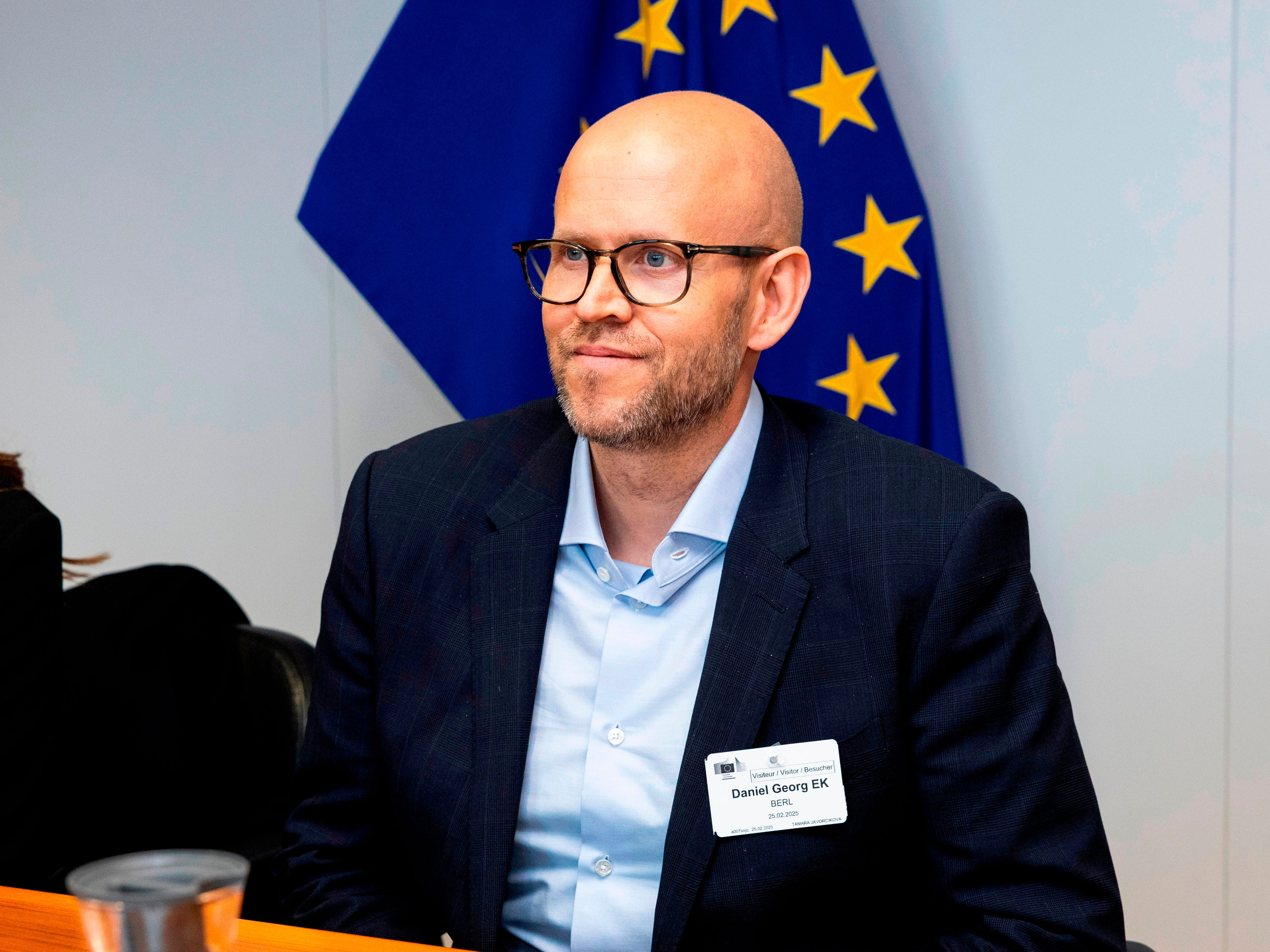
Swedish businessman Daniel Ek is the co-founder and CEO of Spotify, although he is due to step down from the chief executive job in January 2026 after two decades at the helm. Founded in Sweden in 2006, Spotify started as a response to the piracy problem in music, and eventually grew to become the dominant player in music streaming.
Spotify changed the music industry forever. It also made Ek a billionaire. The 42-year-old also has other business interests, one of which is an investment company called Prima Materia, which pledged to invest in ambitious European startups when it was established in 2021.
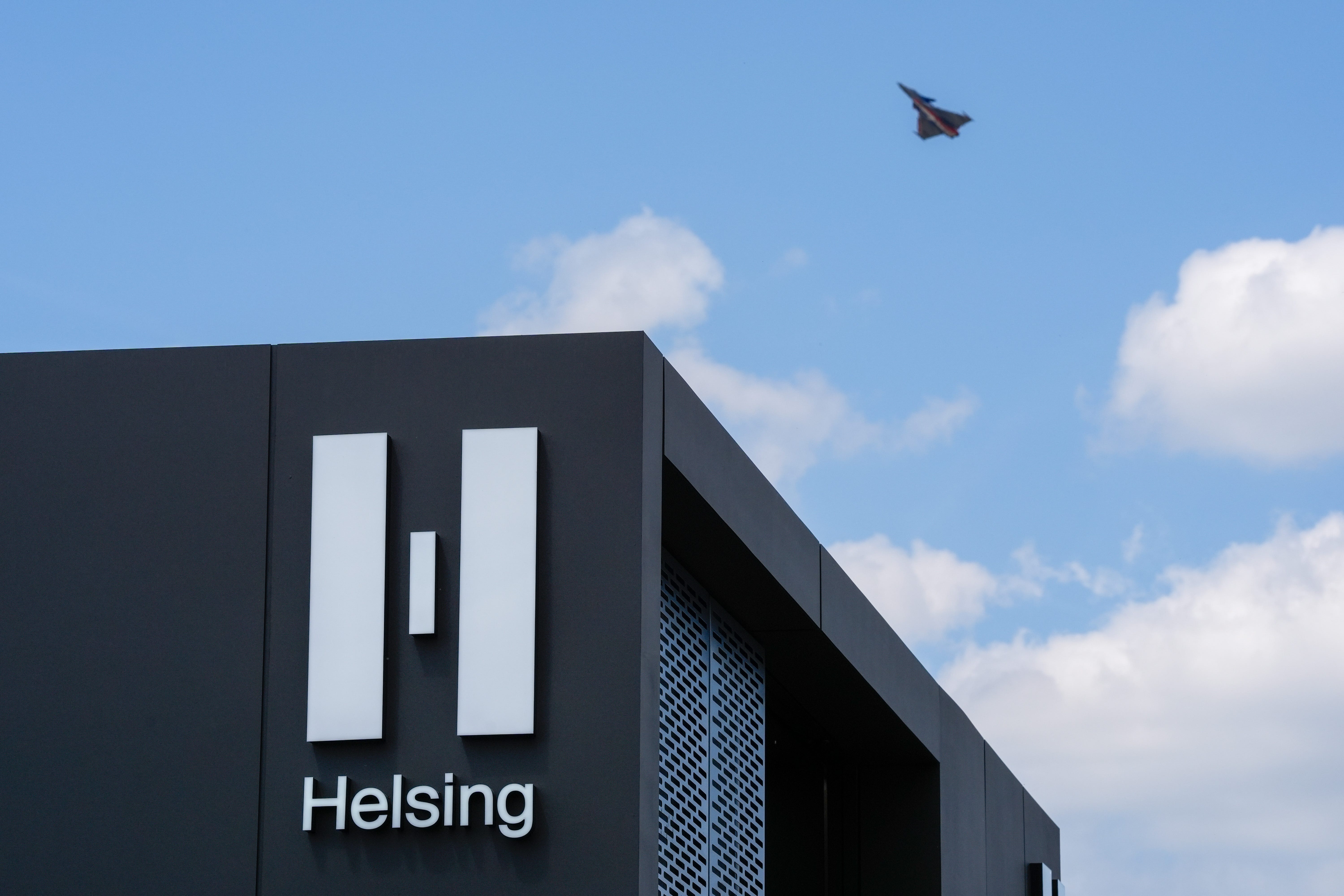
Prima Materia was an early investor in the German military technology company Helsing, which was founded in 2021. Ek is currently the chairman of the firm, which specializes in developing aerial and underwater drones as well as AI software for weapons systems.
The latest Helsing funding round — led by Prima Materia — in June 2025 raised €600 million, boosting the company’s overall valuation to $12 billion, according to news reports at the time.
The investment round brought Ek’s involvement in military tech back into public consciousness. Despite the companies of Spotify and Helsing being separate entities, the Daniel Ek link prompted some artists to pull their music from Spotify over their opposition to weapons funding.
Confusion as artist boycott movements name-drop Israel
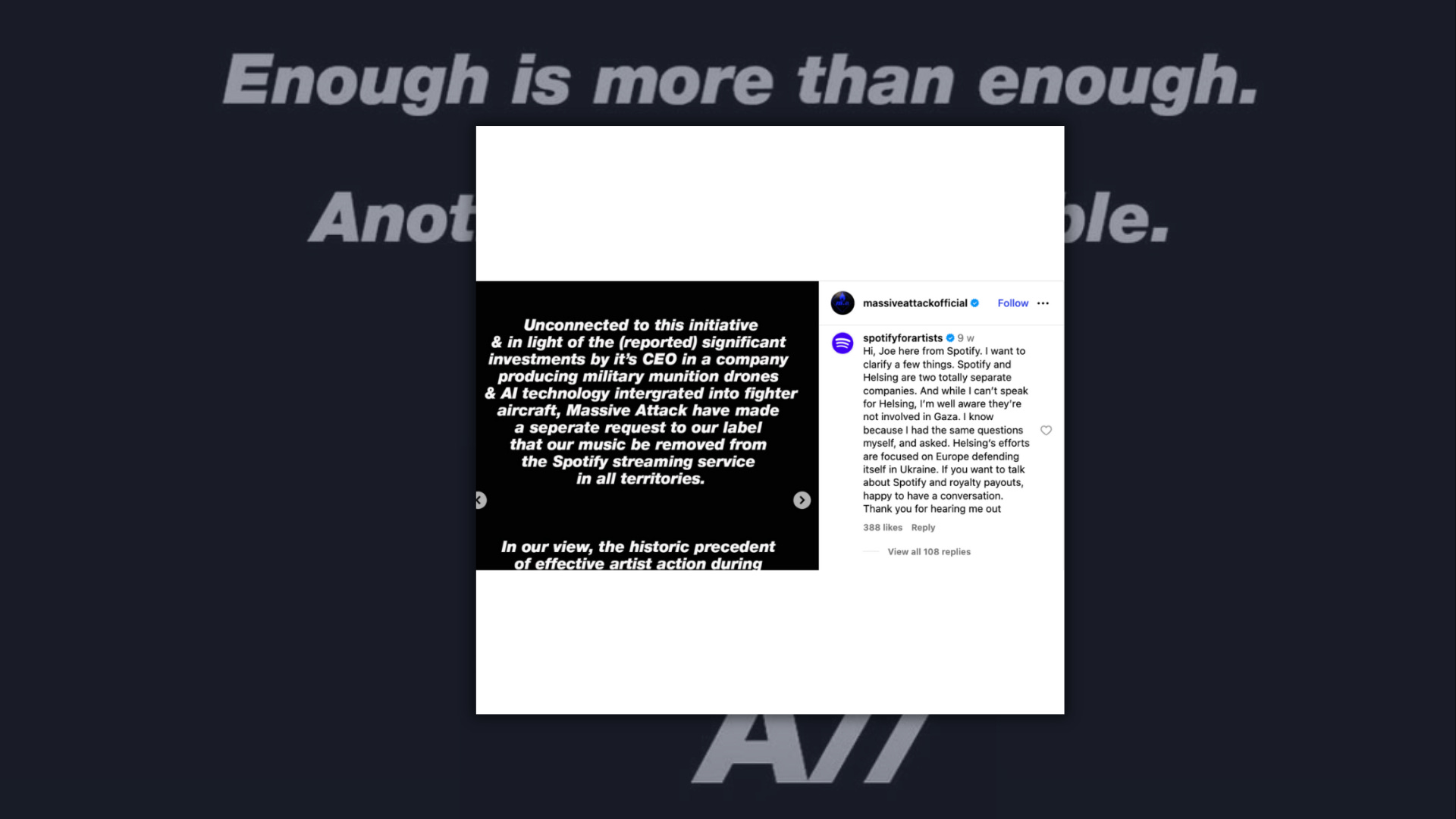
One of those was Massive Attack, who called it a “moral and ethical burden” in which “the hard-earned money of fans and the creative endeavours of musicians ultimately funds lethal, dystopian technologies”. The statement by Massive Attack also contributed to the confusion about where Helsing’s tech was being used.
The announcement about the band’s pulling out of Spotify over Daniel Ek’s business activities came immediately following a statement that was otherwise relating to the ‘No Music for Genocide’ initiative, which the band was also backing and which sees artists calling on Spotify to remove their music from the Israeli market. The ‘No Music for Genocide’ initiative has been signed up to by more than 1,000 musicians and labels, and describes itself as a “cultural boycott” inspired by successful similar efforts against apartheid South Africa.
The Massive Attack statement did specify that the two were separate and distinct causes, but their mixing in one statement helped the spread of claims that Daniel Ek was investing in drones that were being used by Israel.
Rock trio Xiu Xiu made a similar request to remove their music from Spotify, telling fans on Instagram that they were working to take all their music off what they described as “garbage hole violent armageddon portal Spotify.” They added: “Reason: Spotify uses music money to invest in AI war drones.” In a follow-up post, Xiu Xiu made further remarks suggesting the Helsing investment could have something to do with Israel, without providing evidence.
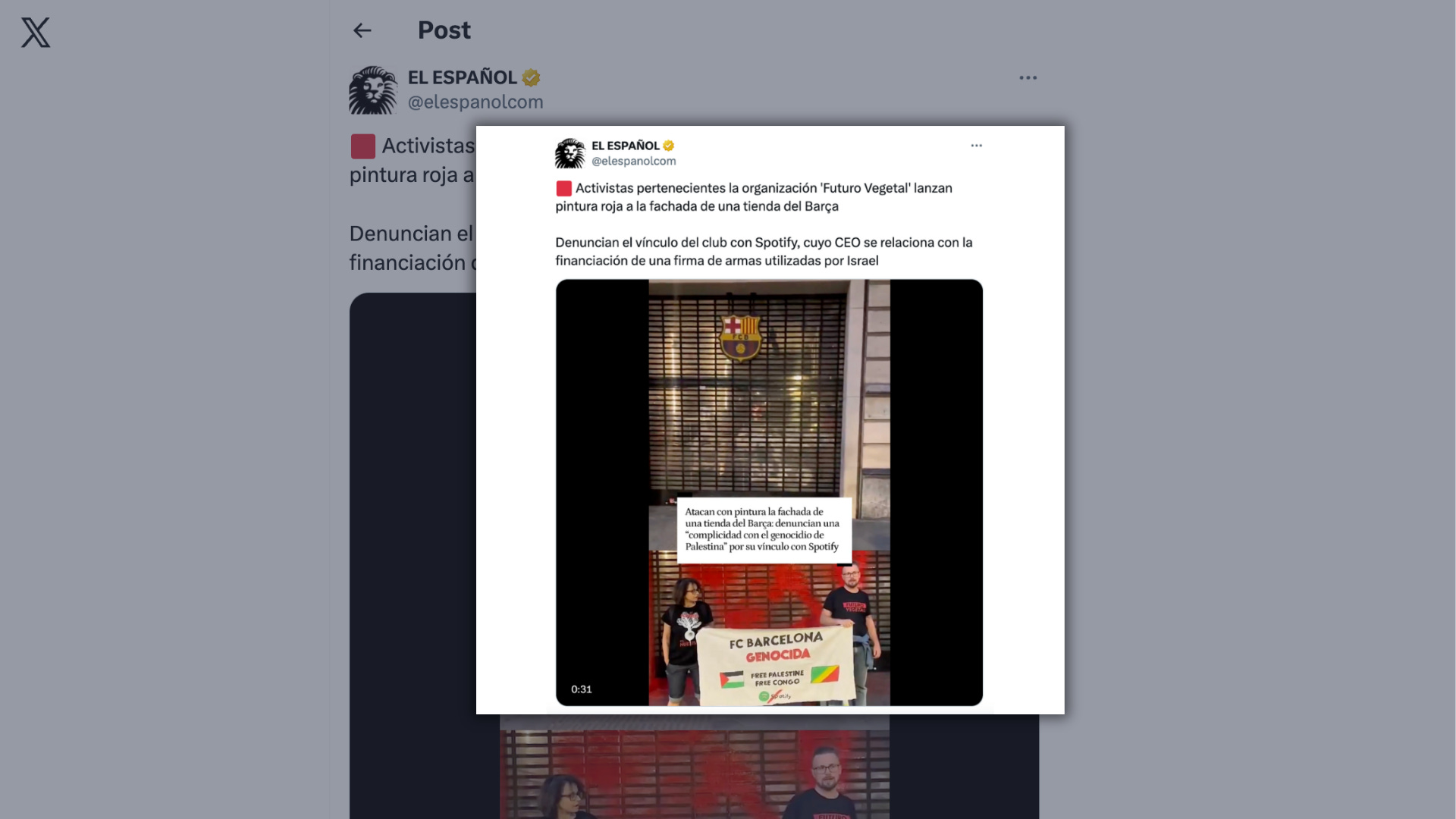
This was a claim that was also seen elsewhere; in September, El Español reported on activists who sprayed red paint on the front of an FC Barcelona shop to “denounce the club’s link with Spotify, whose CEO is associated with the financing of a weapons company used by Israel”.
A more recent example from Spain in mid-November saw a collective of more than 160 musicians and bands from the Basque region in the north of the country launch a boycott against Spotify over the CEO’s other investments in AI drones. The pro-Palestine collective, called Musikariak Palestinarekin (Musicians with Palestine), mentioned Daniel Ek’s investment in military tech among their reasons; other reasons were issues around pay and the treatment of artists by the streaming giant.
The Basque music collective specified that the goal was to free their music from the war industry at large, but as a Palestine-specific activist group, it also mentioned that Ek’s investment came “in the context of genocide and war”. Some of the news coverage about this large-scale boycott explicitly mentioned a link between Helsing technology and Israel.
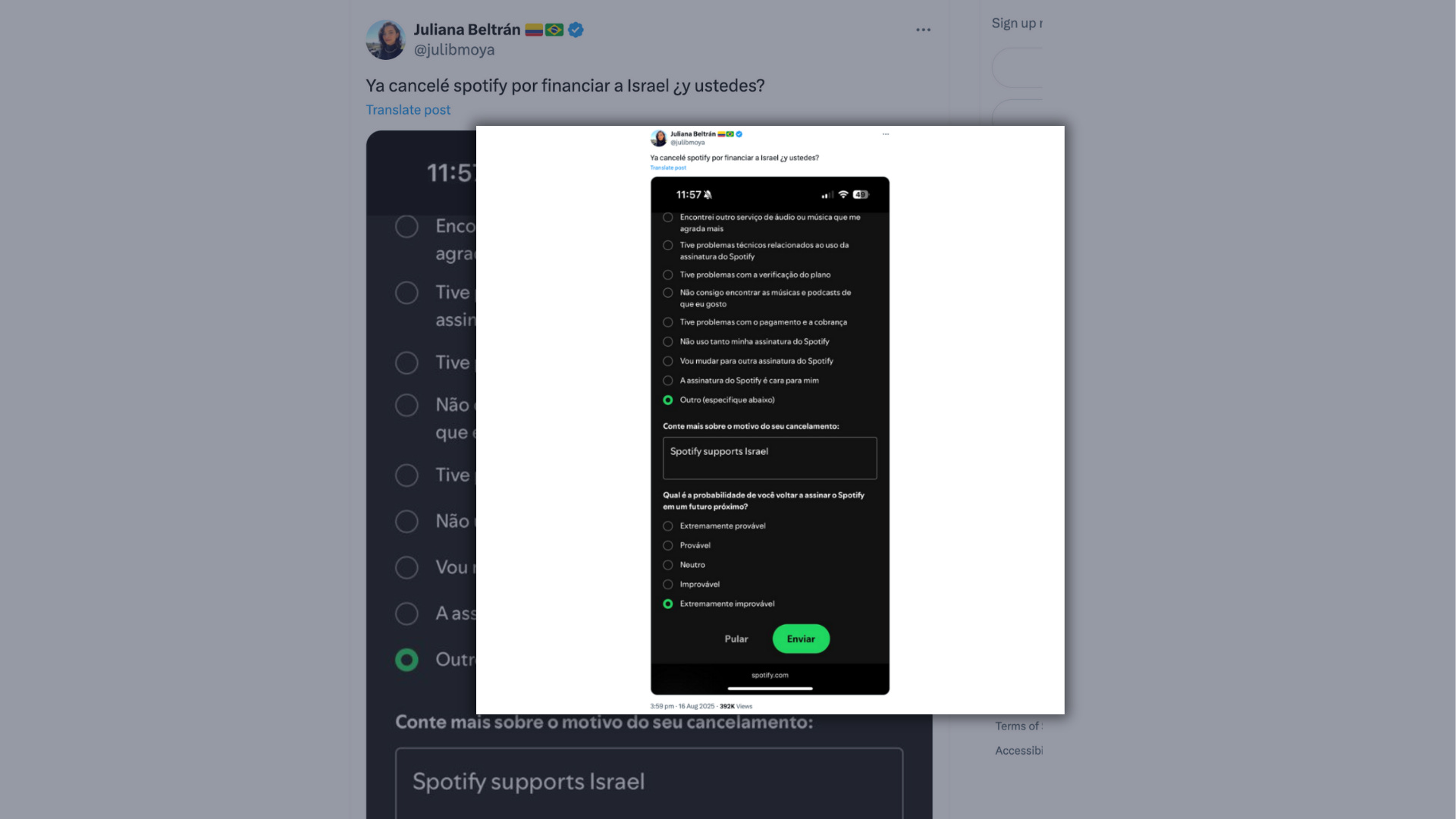
Outside of the artist boycott, customers were also reporting that they were cancelling their Spotify accounts over the company’s perceived support of Israel.
Other posts linked Helsing and weapons manufacturer Saab. Saab is indeed an investor and strategic partner of Helsing, and the Swedish company Saab does have business relationships in Israel — the CEO Micael Johannson had previously said: “We have some companies in Israel supporting us in the supply chain.”
Despite the interconnectedness of Western defence industry, there was no evidence directly linking Helsing to operations in Israel. The company also responded to what it called “misinformation” over where its products were being used.
Helsing says tech is used in Ukraine only
In response to the circulating theories back in September, Helsing released a statement. In it, the company said: “Currently we see misinformation spreading that Helsing’s technology is deployed in war zones other than Ukraine. This is not correct. Our technology is deployed to European countries for deterrence and for defence against the Russian aggression in Ukraine only.”
Spotify has also sought to separate itself from the Helsing story. An employee operating an official Spotify for Artists account commented on the Massive Attack statement, writing: “I want to clarify a few things. Spotify and Helsing are two totally separate companies. And while I can’t speak for Helsing, I’m well aware they’re not involved in Gaza. I know because I had the same questions myself, and asked. Helsing’s efforts are focused on Europe defending itself in Ukraine. If you want to talk about Spotify and royalty payouts, happy to have a conversation.”
Spotify has been contacted for further comment. Its response to other news outlets reporting on the reaction to Ek’s investment has pointed journalists to the Helsing statement.
With Ek soon to step out of his CEO role at Spotify, the streaming giant has said that decision had nothing to do with any recent controversy. Ek will continue on as executive chairman of Spotify, and said he will remain involved in the running of the company.
And despite the clarification from Helsing and a lack of any other evidence that its drones are used anywhere other than Ukraine, the claims linking it with Israel have persisted and appear to be growing in Spain, where the boycott movement is gaining traction in the Basque Country, and in Latin America.
Boycotts founded in misinformation
There are other instances in which boycotts have stemmed from misinformation or exaggerated claims and led to very real financial consequences for major companies.
In 2023, Bud Light sent a personalized beer can to Dylan Mulvaney, a transgender influencer, for a social media post as part of an influencer partnership. It led to a right-wing boycott, with false claims that the cans would all feature Mulvaney’s face receiving widespread attention, as well as an understanding that there was a wider advertising deal at play.
The CEO of Bud Light’s parent company Anheuser-Busch InBev, Michel Doukeris, told the Financial Times that “misinformation and confusion” around the scope of the partnership with Mulvaney — including digitally altered images of billboards featuring her and a can of Bud Light — hit sales of the product (some reports estimated the loss at over a billion dollars.) While anti-transgender boycotters were generally unhappy that Bud Light would work with Mulvaney at all, the exaggeration of the story on social platforms heightened the backlash, and led to one of the largest boycotts of a consumer brand in U.S. history.
For now, the boycott of Spotify does not appear to have hurt the streaming business; reporting its third quarter earnings for 2025, Spotify said it had surpassed 700 million Monthly Active Users, while paid subscribers climbed 12% year on year. The company’s total revenue also grew 12% since the same time the previous year.
The statement on November 4 quoted Daniel Ek as saying: “The business is healthy … It all comes back to user fundamentals and that’s where we are: 700 million users who keep coming back, engagement at all-time highs. We’re building Spotify for the long-term.”
SOURCES
Stupples, B. (2022). Spotify CEO Daniel Ek Builds ‘Insane’ $1 Billion Bet on European Tech Startups. [online] Bloomberg.com. [Accessed 21 Nov. 2025].
Instagram. (2025). Massive Attack on Instagram: ‘In 1991 the scourge of apartheid violence fell from South Africa, aided from a distance by public boycotts, protests… [online] [Accessed 21 Nov. 2025].
Instagram. (2017). Xiu Xiu For Life on Instagram: ‘Reason: Spotify uses music money to invest in AI war drones.’ [online] [Accessed 21 Nov. 2025].
X (formerly Twitter). (2025). Available at: Activistas pertenecientes la organización ‘Futuro Vegetal’ lanzan pintura roja a la fachada de una tienda del Barça [Accessed 24 Nov. 2025].
Instagram. (2017). Musikariak Palestinarekin on Instagram: ‘Zer gertatu da Spotifyrekin? Boikot Spotify!’ [online] [Accessed 24 Nov. 2025].
Sherman, N. (2025). Spotify founder Daniel Ek to step down as chief executive. [online] Bbc.com. [Accessed 24 Nov. 2025].
Nomusicforgenocide.org. (2025). No Music For Genocide. [online] [Accessed 25 Nov. 2025].
X (formerly Twitter). (2025). Available at: Ya cancelé spotify por financiar a Israel ¿y ustedes? [Accessed 25 Nov. 2025].
IISS. (2023). Western defence companies scale up production, but Gaza moves goalposts. [online] [Accessed 25 Nov. 2025].
X (formerly Twitter). (2025). Available at: CEO of Spotify Daniel Ek (@eldsjal) invests in military AI technology and supports Israel. [Accessed 25 Nov. 2025].
Helsing.ai. (2025). Helsing raises €600m to invest in European technological sovereignty – Helsing. [online] [Accessed 25 Nov. 2025].
Spotify Newsroom (2025). Spotify Reports Third Quarter 2025 Earnings — Spotify. [online] Spotify. [Accessed 26 Nov. 2025].
Sugiura, E. (2023). AB InBev boss blames social media ‘misinformation’ for backlash against Bud Light. [online] @FinancialTimes. [Accessed 26 Nov. 2025].
Mukherjee, S. (2025). Spotify founder Daniel Ek pivots from music to European tech ventures. [online] Reuters. [Accessed 26 Nov. 2025].
Ziady, H. (2024). Bud Light boycott likely cost Anheuser-Busch InBev over $1 billion in lost sales. [online] CNN. [Accessed 26 Nov. 2025].