


Throughout summer 2026, there were a number of developments in the AI content space — most notably, in the detection of that content.
Many of the world’s biggest tech companies — like Meta and TikTok, which are now also AI companies — have introduced AI content detectors in recent months. Others were earlier on the scene, like Google with its SynthID watermarking system.
Governments and international blocs like the EU are beginning to regulate artificial intelligence, so more detectors and other new ways to safeguard against false content may begin to emerge. Since August 2, all AI-generated or modified content is required to be labelled in the European Union under the bloc’s AI Act.
The upcoming U.S. Midterm elections in November may also be front of mind for these American giants of technology (Meta said AI transparency is one of its priorities for the elections). As election cycles become increasingly characterised by online AI slop, and amid concerns that deepfakes could influence voting, content provenance and AI detection are becoming more important than ever.
Google DeepMind SynthID
Google SynthID is an imperceptible watermark that is embedded into content generated or altered with Google’s own AI programs. A detector to pick up on that watermark was introduced internally several years ago, with a public-facing version made available to journalists and early testers in 2025, before being made widely available within the company’s Gemini LLM, Google Chrome and Google Search in late 2025 into 2026. SynthID is able to detect images, audio and video created using Google tools.
Limitations: The system is not entirely bulletproof. If a piece of content is very compressed or has been transformed substantially — for example, with heavy filters or edits — it could struggle to detect accurately. We have also seen it fail to detect a photo of a screen showing a Google AI-generated image, which gives an idea of the ways an image could be transformed to escape detection. There are file size limits, too, although they’re not as restrictive as some of the detectors on this list (100 MB for video, images and audio.)
Google’s SynthID only works on items made with Google AI. And as with any new detection system, there are also people working hard to find ways to circumvent it. Internet users have created tools that claim to remove SynthID watermarks. As more time goes on, it’s worth being aware that innovation is also happening on the other side of the ecosystem.

How to access: There is a dashboard version of the detector that Google DeepMind has made available to early testers and journalists working in fact-checking and verification. However, everyone can use the tool by putting an image or video into Gemini and simply asking if it was made with AI. Google has also added verification for C2PA Content Credentials to Gemini.
OpenAI verify tool
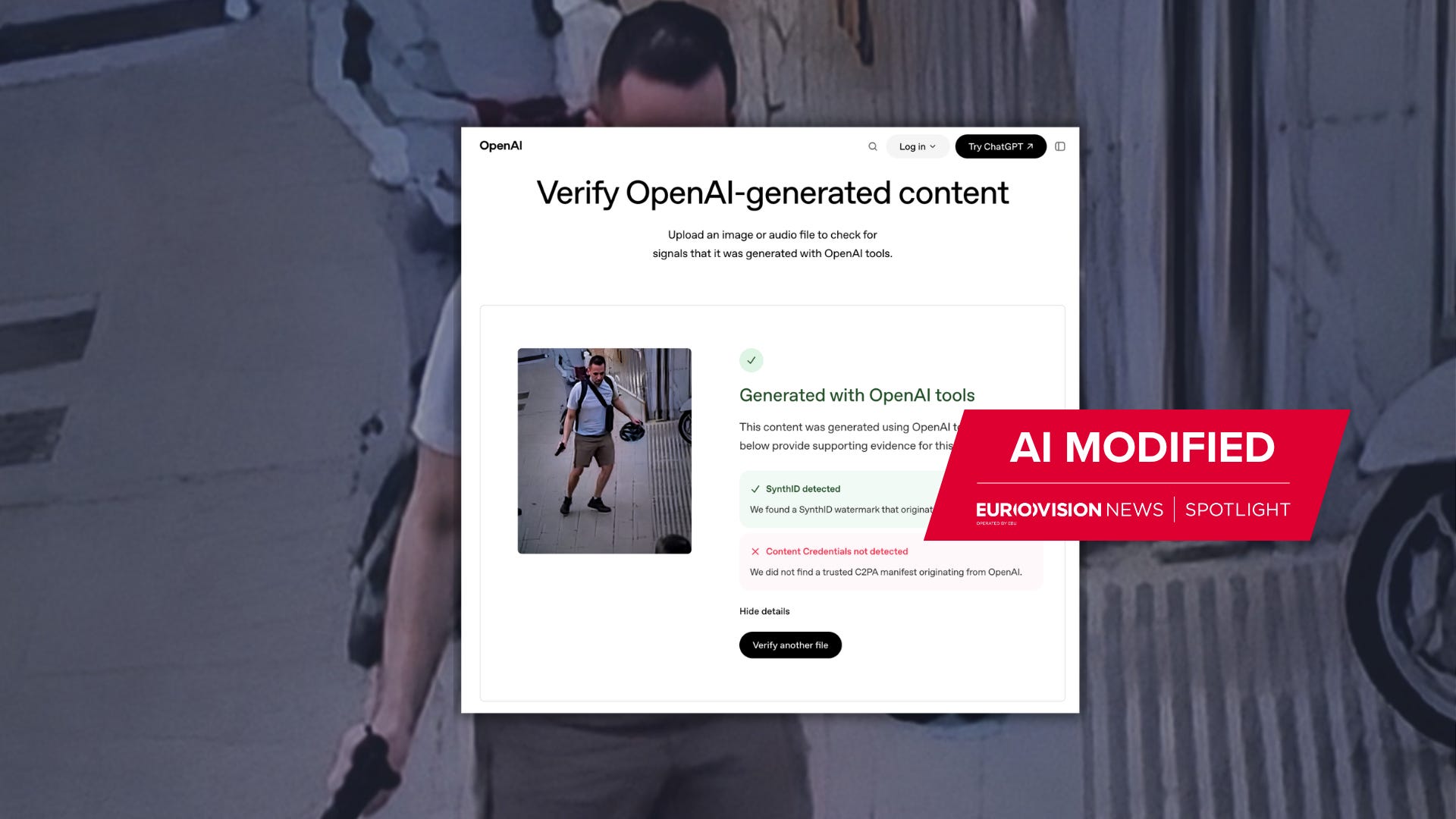
OpenAI released its own similar detection tool in 2026. Despite the obvious rivalry, the AI giant teamed up with Google to adopt SynthID watermarking, which is now being embedded in materials generated by OpenAI tools — including ChatGPT, the OpenAI API, or Codex. The OpenAI detector also looks for provenance signals like C2PA metadata.
Limitations: The detector is currently limited to still images and audio files, so it’s not yet possible to check videos created using OpenAI tools. Researchers and journalists are trying workarounds, like checking screenshots from videos which could give an indication as to the provenance of the overall clip.
Otherwise, the same limitations apply as with Google SynthID; heavy compression or tampering, or the metadata being stripped, could hamper detection. Since OpenAI’s use of watermarks is newer, it would also fail to detect content generated from a legacy model before watermarking was implemented. As with Google’s detector, this one only works on content generated or modified by OpenAI.
How to access: A publicly available dashboard where items can be dragged and dropped in for check is available here.
Meta AI identification
Meta already had its own AI detection systems being used internally, but during the summer, it released a publicly available scanner for people to check content themselves.
Meta is not using Google’s SynthID — but it is using its own Content Seal watermark to detect materials made with Meta tools, including the new image-generation model, Muse Image.
Limitations: With the detector and the image model itself being so new, there has not been as much extensive testing done by journalists or researchers as the previous options. A Reuters analysis in July found that Meta’s detection tool failed to identify some of its own AI-generated images once they were cropped.
Since cropping is one of the most common transformations an image could undergo before being reshared, it highlighted the challenges of verifying AI-generated images. Meta told Reuters that the tool was a preview, and added that the watermark was designed to remain intact after common edits, but the signal may be lost if an image is heavily cropped. As with all detectors, it may be a good way to do an initial check, but traditional verification methods are still needed.
There’s also a 50 MB size limit on videos right now, which might make scanning higher-quality videos tricky.
How to access: A dashboard where users can drop in an image, video or audio file — or even paste a public URL — is available to try out here.
ByteDance’s TikTok AI detector
Over the summer, TikTok discreetly launched a preview website where content could be uploaded for detection. The tool is designed to identify whether an image or video was generated or edited with AI tools from within the ByteDance shed, including TikTok, CapCut, Dreamina, Hypic, and Pippit.
TikTok said that this type of AI content is usually already labelled when you see it on the platforms, but a detector would be useful for content that makes its way across the wider internet.
Similar to the other detectors, it uses a combination of C2PA metadata and “invisible watermarks”. With the tool still in preview mode, more time is needed to check out just how effective TikTok’s answer to AI detection is.
Limitations: In TikTok’s own words, “no AI detection tool is 100% foolproof”. It says there may be cases where AI-generated content was made with its platforms but has weak signals, due to the metadata being stripped, the watermark being degraded, or content predating the introduction of these signals.
There are also limits on the file sizes that can be uploaded to the detector — up to 20 MB for images, up to 100 MB for videos.
How to access: A preview dashboard where content can be uploaded for a check can be found here.
Nvidia’s Synthetic Video Detector
Another detector emerged this summer from one of the world’s leading AI companies, Nvidia. This one promises something different. Pitched as the solution to a concern in newsrooms and other media environments, the Nvidia Synthetic Video Detector (SVD) will not be available to the general public — although a demo is available to try.
This is a micro-service by Nvidia aimed at broadcasters, news agencies, content moderators and more, that promises to eventually allow for detection even in livestream situations.
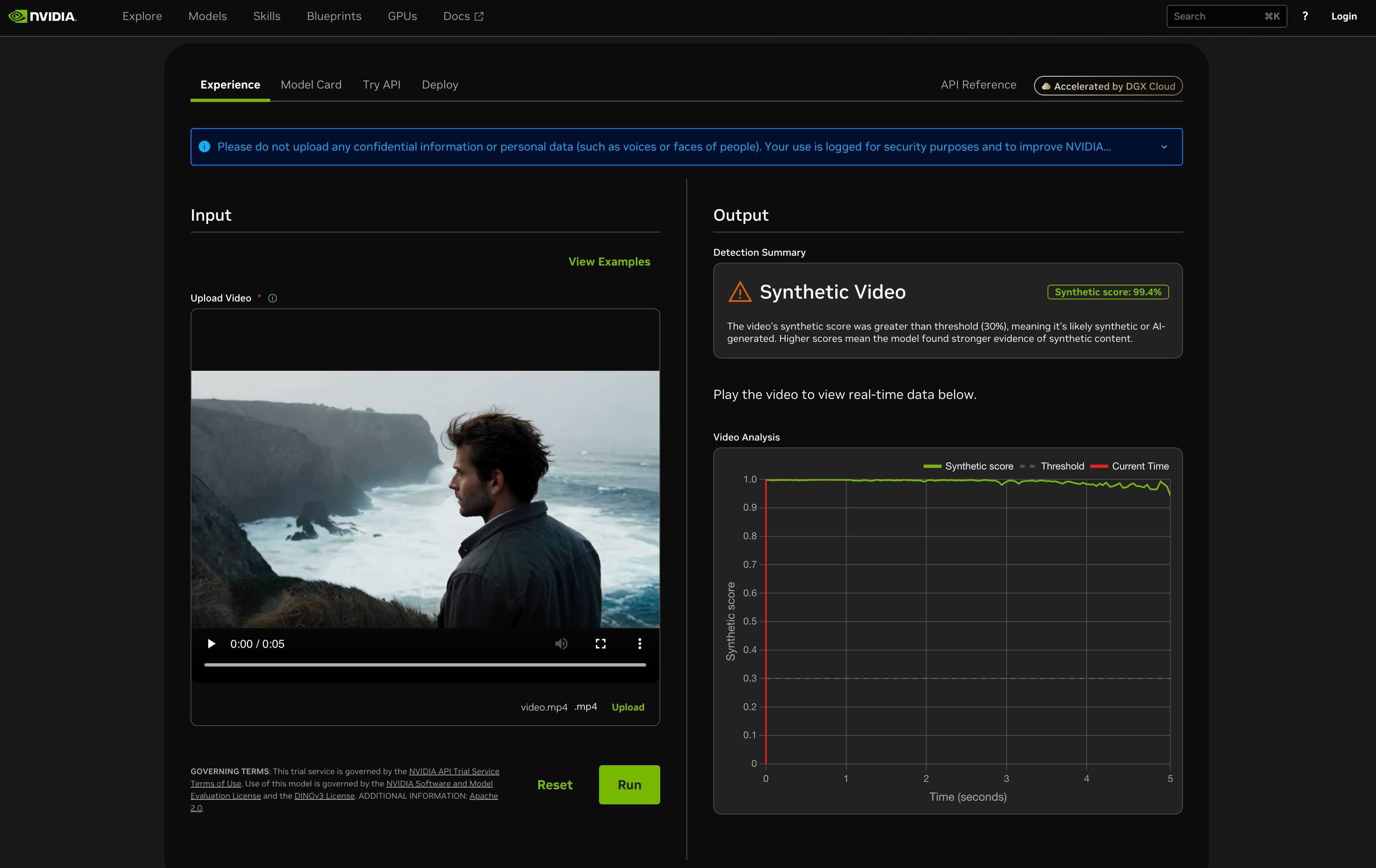
Unlike the others, this detector does not rely on watermarks and will not be limited to content from certain models — so it should work as a general detector for a wide range of AI-generated videos. It analyses statistical and frequency-domain traces that are often seen in AI-generated videos, giving per-frame detection scores as well as an overall synthetic probability for the entire video, the company says.
Limitations: The demo version of this detector can be slow to process and has a maximum file size of 100 MB — and it only works on videos. Nvidia says the signals it checks are resilient to common video transformations like compression and re-encoding. We had mixed results with the demo, but it’s still early days for this detector.
How to access: The demo version is available to try here.